501 posters, 2 videos, 1 audios, 8 topics, 37 sessions, 395 authors, 307 institutions
ePostersLive by SciGen Technologies S.A. All rights reserved.
23rd Annual Pain Medicine Meeting 2024
November 21-23, 2024 | Caesars Palace, Las Vegas, Nevada

6276
MANAGEMENT OF REFRACTORY CHRONIC ABDOMINAL PAIN IN A STAGE IV OVARIAN CANCER PATIENT USING DORSAL ROOT GANGLION STIMULATION
Poster Presenter
Part of Topic
Medically Challenging Cases
Management of Refractory Chronic Abdominal Pain in a Stave IV Ovarian Cancer Patient Using Dorsal Root Ganglion Spinal Stimulation
Effective pain management significantly impacts health-related quality of life (HRQOL)
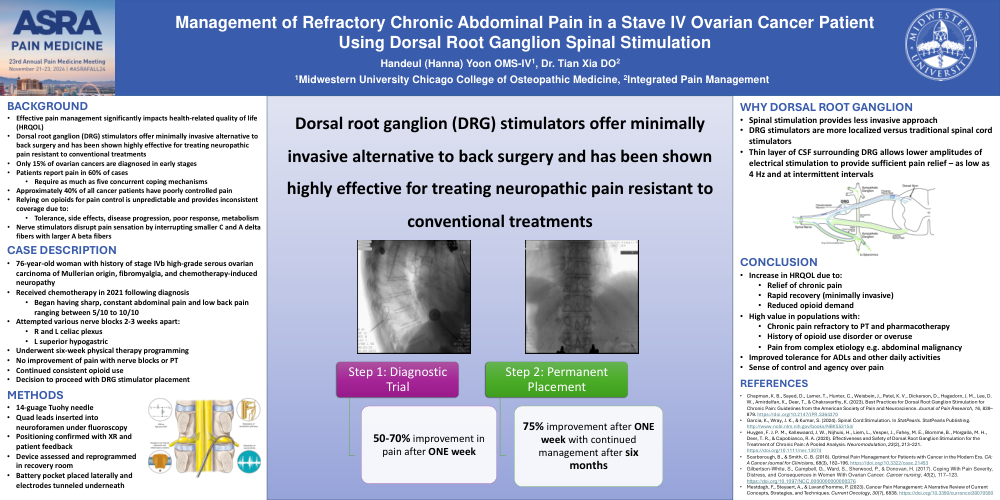
Dorsal root ganglion (DRG) stimulators offer minimally invasive alternative to back surgery and has been shown highly effective for treating neuropathic pain resistant to conventional treatments
•76-year-old woman with history of stage IVb high-grade serous ovarian carcinoma of Mullerian origin, fibromyalgia, and chemotherapy-induced neuropathy
•Received chemotherapy in 2021 following diagnosis
•Began having sharp, constant abdominal pain and low back pain ranging between 5/10 to 10/10
•Attempted various nerve blocks 2-3 weeks apart:
•R and L celiac plexus
•L superior hypogastric
•Underwent six-week physical therapy programming
•No improvement of pain with nerve blocks or PT
•Continued consistent opioid use
•Decision to proceed with DRG stimulator placement
•14-guage Tuohy needle
•Quad leads inserted into neuroforamen under fluoroscopy
•Positioning confirmed with XR and patient feedback
•Device assessed and reprogrammed in recovery room
•Battery pocket placed laterally and electrodes tunneled underneath
•Spinal stimulation provides less invasive approach
•DRG stimulators are more localized versus traditional spinal cord stimulators
•Thin layer of CSF surrounding DRG allows lower amplitudes of electrical stimulation to provide sufficient pain relief – as low as 4 Hz and at intermittent intervals
•Increase in HRQOL due to:
•Relief of chronic pain
•Rapid recovery (minimally invasive)
•Reduced opioid demand
•High value in populations with:
•Chronic pain refractory to PT and pharmacotherapy
•History of opioid use disorder or overuse
•Pain from complex etiology e.g. abdominal malignancy
•Improved tolerance for ADLs and other daily activities
•Sense of control and agency over pain
Dorsal root ganglion (DRG) stimulators offer minimally invasive alternative to back surgery and has been shown highly effective for treating neuropathic pain resistant to conventional treatments