501 posters, 2 videos, 1 audios, 8 topics, 37 sessions, 395 authors, 307 institutions
ePostersLive by SciGen Technologies S.A. All rights reserved.
23rd Annual Pain Medicine Meeting 2024
November 21-23, 2024 | Caesars Palace, Las Vegas, Nevada

6206
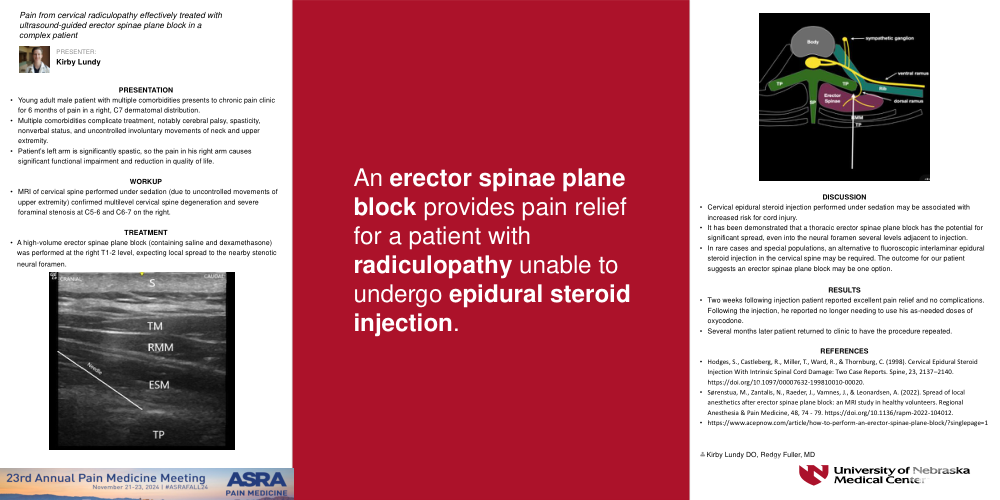
PAIN FROM CERVICAL RADICULOPATHY EFFECTIVELY TREATED WITH ULTRASOUND-GUIDED ERECTOR SPINAE PLANE BLOCK IN A COMPLEX PATIENT
Poster Presenter
Authors
Affiliations
Part of Topic
Medically Challenging Cases
Pain from cervical radiculopathy effectively treated with
ultrasound-guided erector spinae plane block in a
complex patient
An erector spinae plane
block provides pain relief
for a patient with
radiculopathy unable to
undergo epidural steroid
injection.
PRESENTATION
• Young adult male patient with multiple comorbidities presents to chronic pain clinic
for 6 months of pain in a right, C7 dermatomal distribution.
• Multiple comorbidities complicate treatment, notably cerebral palsy, spasticity,
nonverbal status, and uncontrolled involuntary movements of neck and upper
extremity.
• Patient’s left arm is significantly spastic, so the pain in his right arm causes
significant functional impairment and reduction in quality of life.
WORKUP
• MRI of cervical spine performed under sedation (due to uncontrolled movements of
upper extremity) confirmed multilevel cervical spine degeneration and severe
foraminal stenosis at C5-6 and C6-7 on the right.
TREATMENT
• A high-volume erector spinae plane block (containing saline and dexamethasone)
was performed at the right T1-2 level, expecting local spread to the nearby stenotic
neural foramen.
DISCUSSION
• Cervical epidural steroid injection performed under sedation may be associated with
increased risk for cord injury.
• It has been demonstrated that a thoracic erector spinae plane block has the potential for
significant spread, even into the neural foramen several levels adjacent to injection.
• In rare cases and special populations, an alternative to fluoroscopic interlaminar epidural
steroid injection in the cervical spine may be required. The outcome for our patient
suggests an erector spinae plane block may be one option.
RESULTS
• Two weeks following injection patient reported excellent pain relief and no complications.
Following the injection, he reported no longer needing to use his as-needed doses of
oxycodone.
• Several months later patient returned to clinic to have the procedure repeated.
REFERENCES
• Hodges, S., Castleberg, R., Miller, T., Ward, R., & Thornburg, C. (1998). Cervical Epidural Steroid
Injection With Intrinsic Spinal Cord Damage: Two Case Reports. Spine, 23, 2137–2140.
https://doi.org/10.1097/00007632-199810010-00020.
• Sørenstua, M., Zantalis, N., Raeder, J., Vamnes, J., & Leonardsen, A. (2022). Spread of local
anesthetics after erector spinae plane block: an MRI study in healthy volunteers. Regional
Anesthesia & Pain Medicine, 48, 74 - 79. https://doi.org/10.1136/rapm-2022-104012.
• https://www.acepnow.com/article/how-to-perform-an-erector-spinae-plane-block/?singlepage=1
Kirby Lundy DO, Redgy Fuller, MD