501 posters, 2 videos, 1 audios, 8 topics, 37 sessions, 395 authors, 307 institutions
ePostersLive by SciGen Technologies S.A. All rights reserved.
23rd Annual Pain Medicine Meeting 2024
November 21-23, 2024 | Caesars Palace, Las Vegas, Nevada

6202
INTRATHECAL PUMP: LOW RATE CATHETER GRANULOMA
Poster Presenter
Authors
Affiliations
Part of Topic
Medically Challenging Cases
Intrathecal targeted drug therapy is the administration of analgesic and/or anti-spasmodic medications directly into a patient’s spinal fluid for pain and spasticity control. With the use of intrathecal drug delivery system (“IDDS”), providers can use much lower doses of analgesics to improve pain control, while limiting the side effect burden associated with higher doses of systemic analgesics[1]. However, there are several risks in using IDDS, such as complications associated with intrathecal catheter insertion, surgical pump implantation, device management, drug refills, and adverse effects of therapeutic drugs[2]. This case report highlights an unusual complication of an IDDS.
59 year old male with a past medical history of degenerative disc disease, lumbosacral spondylosis status post multi level lumbar laminectomy and fusion, status post right intrathecal narcotic pump and spinal cord stimulator implant who presented with low back, new acute left foot weakness and urinary incontinence developing three weeks after SCS implant. Patient complains of increased pain radiating from his hips down for the past one month, causing him to turn off his SCS.
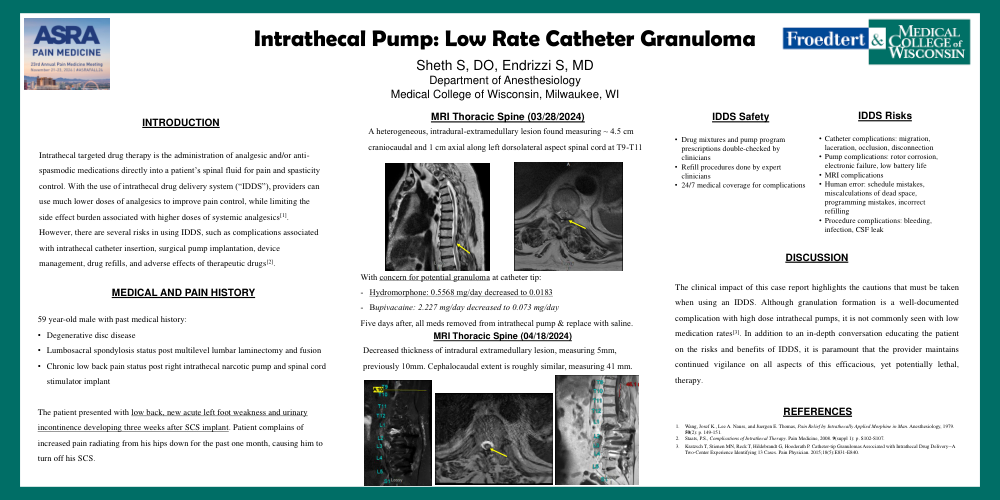
Since patient was also reporting increased withdrawal symptoms (ex. restlessness, sweating), clinical opiate withdrawal scale (COWS) was initiated along symptomatic treatment with clonidine. Neurosurgery recommended thoracolumbar decompression, however patient reluctant to have this procedure. MRI lumbar and thoracic spine ordered and showed metallic artifact, which could possibly indicate catheter tip granuloma. A heterogeneous, intradural-extramedullary lesion found measuring approximately 4.5 cm craniocaudal and 1 cm axial along the left dorsolateral aspect spinal cord at T9-T11 level. With concern for potential granuloma at the site of the catheter tip, hydromorphone dose was decreased from 0.5568 mg/day to 0.0183 and bupivacaine was decreased from 2.227 mg/day to 0.073 mg/day. Five days thereafter, conservatively, all medications were removed from intrathecal pump and replace with saline given concern for granuloma. Ninety days later, repeat MRI showed decreased thickness of enhancing intradural extramedullary lesion at the T9-T11 levels, measuring 5mm, previously 10mm.
The clinical impact of this case report highlights the cautions that must be taken when using an IDDS. Although granulation formation is a well-documented complication with high dose intrathecal pumps, it is not commonly seen with low medication rates[3]. In addition to an in-depth conversation educating the patient on the risks and benefits of IDDS, it is paramount that the provider maintains continued vigilance on all aspects of this efficacious, yet potentially lethal, therapy.