501 posters, 2 videos, 1 audios, 8 topics, 37 sessions, 395 authors, 307 institutions
ePostersLive by SciGen Technologies S.A. All rights reserved.
23rd Annual Pain Medicine Meeting 2024
November 21-23, 2024 | Caesars Palace, Las Vegas, Nevada

6103
CURE OF COMPLEX REGIONAL PAIN SYNDROME AFTER SCS TRIAL
Poster Presenter
Authors
Affiliations
Part of Topic
Medically Challenging Cases
Spinal cord stimulation has been successful in treatment of complex regional pain syndrome (CRPS)1. There is paucity of information in the literature regarding spinal cord stimulation curing CRPS in the lower extremity2. We present a case of cured CRPS type 2, after spinal cord stimulation (SCS) in a patient with history of bunion osteotomy corrective surgery.
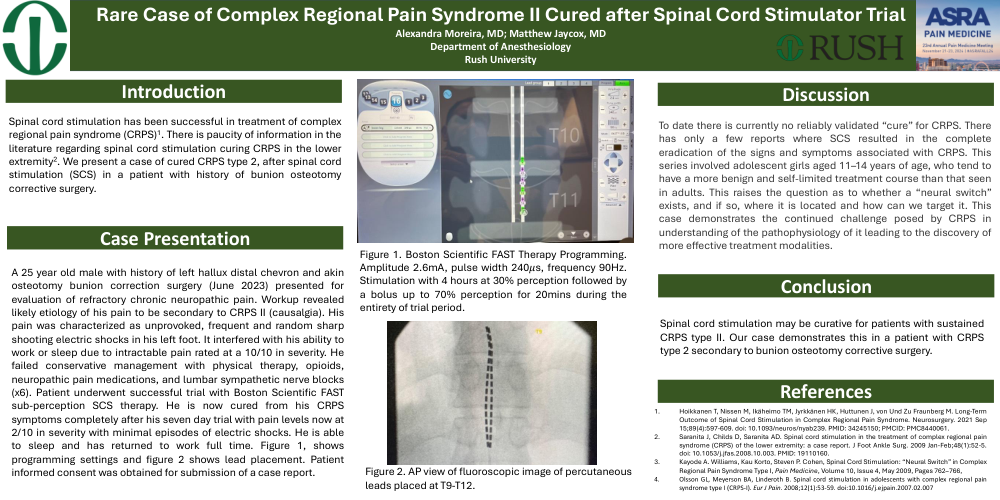
A 25 year old male with history of left hallux distal chevron and akin osteotomy bunion correction surgery (June 2023) presented for evaluation of refractory chronic neuropathic pain. Workup revealed likely etiology of his pain to be secondary to CRPS II (causalgia). His pain was characterized as unprovoked, frequent and random sharp shooting electric shocks in his left foot. It interfered with his ability to work or sleep due to intractable pain rated at a 10/10 in severity. He failed conservative management with physical therapy, opioids, neuropathic pain medications, and lumbar sympathetic nerve blocks (x6). Patient underwent successful trial with Boston Scientific FAST sub-perception SCS therapy. He is now cured from his CRPS symptoms completely after his seven daytrial with pain levels now at 2/10 in severity with minimal episodes of electric shocks. He is able to sleep and has returned to work full time. Figure 1, shows programming settings and figure 2 shows lead placement. Patient informed consent was obtained for submission of a case report.
To date there is currently no reliably validated “cure” for CRPS. There has only a few reports where SCS resulted in the complete eradication of the signs and symptoms associated with CRPS. This series involved adolescent girls aged 11–14 years of age, who tend to have a more benign and self-limited treatment course than that seen in adults. This raises the question as to whether a “neural switch” exists, and if so, where it is located and how can we target it. This case demonstrates the continued challenge posed by CRPS in understanding of the pathophysiology of it leading to the discovery of more effective treatment modalities.
Spinal cord stimulation may be curative for patients with sustained CRPS type II. Our case demonstrates this in a patient with CRPS type 2 secondary to bunion osteotomy corrective surgery.