501 posters, 2 videos, 1 audios, 8 topics, 37 sessions, 395 authors, 307 institutions
ePostersLive by SciGen Technologies S.A. All rights reserved.
23rd Annual Pain Medicine Meeting 2024
November 21-23, 2024 | Caesars Palace, Las Vegas, Nevada

5999
DELAYED PRESENTATION OF HORNER’S SYNDROME AFTER INTERSCALENE BLOCK
Poster Presenter
Authors
Affiliations
Part of Topic
Medically Challenging Cases
Delayed Presentation of Horner’s Syndrome after an Interscalene Block
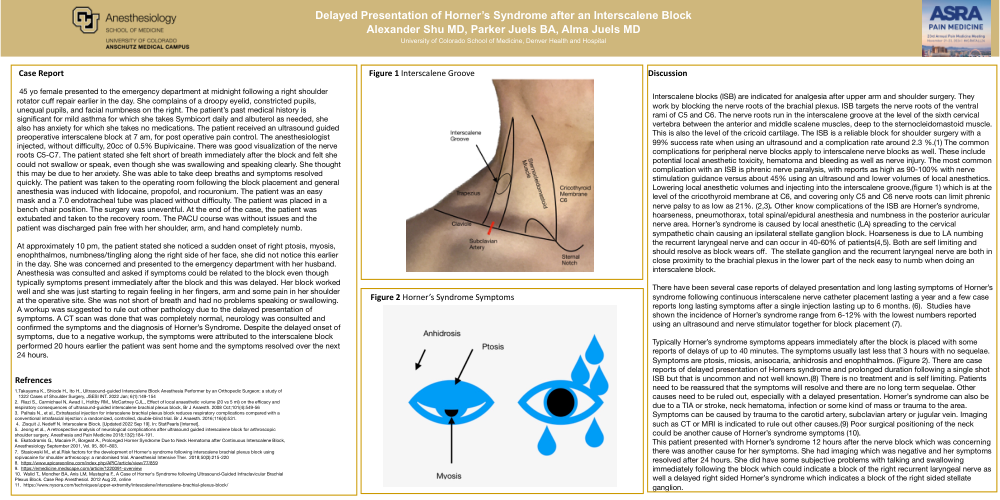
45 yo female presented to the emergency department at midnight following a right shoulder rotator cuff repair earlier in the day. She complains of a droopy eyelid, constricted pupils, unequal pupils, and facial numbness on the right. The patient’s past medical history is significant for mild asthma for which she takes Symbicort daily and albuterol as needed, she also has anxiety for which she takes no medications. The patient received an ultrasound guided preoperative interscalene block at 7 am, for post operative pain control. The anesthesiologist injected, without difficulty, 20cc of 0.5% Bupivicaine. There was good visualization of the nerve roots C5-C7. The patient stated she felt short of breath immediately after the block and felt she could not swallow or speak, even though she was swallowing and speaking clearly. She thought this may be due to her anxiety. She was able to take deep breaths and symptoms resolved quickly. The patient was taken to the operating room following the block placement and general anesthesia was induced with lidocaine, propofol, and rocuronium. The patient was an easy mask and a 7.0 endotracheal tube was placed without difficulty. The patient was placed in a bench chair position. The surgery was uneventful. At the end of the case, the patient was extubated and taken to the recovery room. The PACU course was without issues and the patient was discharged pain free with her shoulder, arm, and hand completely numb.
At approximately 10 pm, the patient stated she noticed a sudden onset of right ptosis, myosis, enophthalmos, numbness/tingling along the right side of her face, she did not notice this earlier in the day. She was concerned and presented to the emergency department with her husband. Anesthesia was consulted and asked if symptoms could be related to the block even though typically symptoms present immediately after the block and this was delayed. Her block worked well and she was just starting to regain feeling in her fingers, arm and some pain in her shoulder at the operative site. She was not short of breath and had no problems speaking or swallowing. A workup was suggested to rule out other pathology due to the delayed presentation of symptoms. A CT scan was done that was completely normal, neurology was consulted and confirmed the symptoms and the diagnosis of Horner’s Syndrome. Despite the delayed onset of symptoms, due to a negative workup, the symptoms were attributed to the interscalene block performed 20 hours earlier the patient was sent home and the symptoms resolved over the next 24 hours.