501 posters, 2 videos, 1 audios, 8 topics, 37 sessions, 395 authors, 307 institutions
ePostersLive by SciGen Technologies S.A. All rights reserved.
23rd Annual Pain Medicine Meeting 2024
November 21-23, 2024 | Caesars Palace, Las Vegas, Nevada

5948
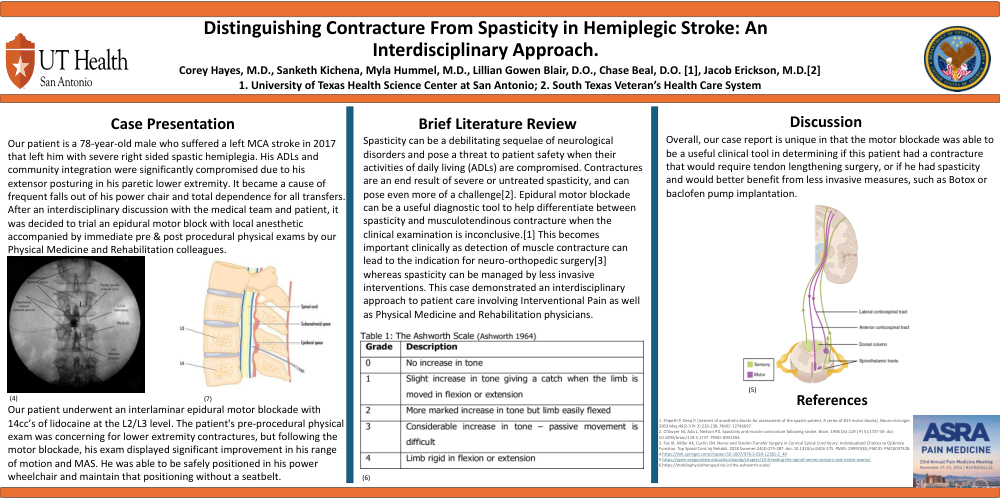
DISTINGUISHING CONTRACTURE FROM SPASTICITY IN HEMIPLEGIC STROKE PATIENT: AN INTERDISCIPLINARY APPROACH.
Poster Presenter
Authors
Affiliations
Part of Topic
Medically Challenging Cases
Spasticity can be a debilitating sequelae of neurological disorders and pose a threat to patient safety when their activities of daily living (ADLs) are compromised. Chronic severe and untreated spasticity has been known to result in contractures which pose even more of a challenge[2]. Epidural motor blockade can be a useful diagnostic tool to help differentiate between spasticity and musculotendinous contracture when the clinical examination is inconclusive.[1] This becomes important clinically as detection of muscle contracture can lead to the indication for neuro-orthopedic surgery[3] whereas spasticity can be managed by less invasive interventions. This case demonstrated an interdisciplinary approach to patient care involving Interventional Pain as well as Physical Medicine and Rehabilitation physicians.
Our patient is a 78 year old male who suffered a left MCA stroke in 2017 that left him with severe right sided spastic hemiplegia. His ADLs and community integration were significantly compromised due to his extensor posturing in his paretic lower extremity. It became a cause of frequent falls out of his power chair and total dependence for all transfers. The patient’s neurorehabilitation team inquired if there were indicated procedures that could assist in determining whether or not he had reversible spasticity or true contracture, as treatment diverges once the distinction is determined. After interdisciplinary discussion with the team and patient, it was decided to trial an epidural motor block with local anesthetic accompanied by immediate pre & post procedural physical exams by our Physical Medicine and Rehabilitation colleagues. Our patient underwent an interlaminar epidural motor blockade with 14cc’s of lidocaine at the L2/L3 level. The patient's pre-procedural physical exam was concerning for lower extremity contractures, but following the motor blockade, his exam displayed significant improvement in his range of motion and MAS. His hip flexion was significantly improved by around 60 degrees, and functionally he was able to be safely positioned in his power wheelchair and maintain that positioning without a seatbelt for the first time.