501 posters, 2 videos, 1 audios, 8 topics, 37 sessions, 395 authors, 307 institutions
ePostersLive by SciGen Technologies S.A. All rights reserved.
23rd Annual Pain Medicine Meeting 2024
November 21-23, 2024 | Caesars Palace, Las Vegas, Nevada

6205
MYSTERIOUS CASE OF GLOSSOPHARYNGEAL NEURALGIA
Poster Presenter
Authors
Affiliations
Part of Topic
Medically Challenging Cases
Mysterious Case of Glossopharyngeal Neuralgia
Keeland Williams MD (Fellow Physician); Christopher Anderson MD (Fellow Physician); QiLiang Chen MD, PhD (Faculty Physician)
Introduction
- Trigeminal (TN) and glossopharyngeal (GPN) neuralgias are common neuropathic syndromes that cause maxillofacial pain
- Due to their similar clinical presentations, differentiating between TN and GPN can prove to be challenging for most clinicians
- Symptoms at presentation
- TN: Shocking pain that is most commonly experienced over the side of the face. It can affect one or multiple aspects of the face: the ophthalmic (V1), zygomatic (V2), or maxillary (V3) zones
- GPN: Deep, unilateral, sporadic, sharp pain localized to the oropharyngeal area
- Both conditions have specific triggers
- Prevalence
- GPN - approx. 0.8 cases per 100,000 in a year
- TN - 4.7 cases per 100,000 per year
- This case shows utility of topical anesthetic nerve block of CN IX
- Assisting the diagnosis of GPN initially confused as TN
Methods for Topical CN IX Nerve Block
- Numeric Rating Scale (NRS): Determined severity of pain before and 30 minutes after topical application of 2% viscous lidocaine
- Patient inserted wick, saturated with 2 % viscous lidocaine, into their posterior oropharynx until contact was established
- Strong and sensitive gag reflex elicited
- Required serial applications of the wick; each time, gag reflex became weaker
- Process repeated until pain reduced to 0/10
Case Report: 55-year-old male presented to the Stanford ED with acute-on-chronic left auricular pain
- ast Medical History: Hypertension, OSA on CPAP, left cisternal TN secondary to venous compression and right supercerebellar artery contacting the right proximal cisternal trigeminal nerve
- Pain Symptoms: Tingling in his left ear with intermittent explosions of deep, dull pain
- Location/Duration: Left periauricular pain for 1 year
- Radiation: Left side of throat and over posterior oropharynx
- Frequency: Occurring every 30–40 minutes, approximately 40 episodes/day
- Timing: Episodes lasting a minute in duration
- Severity: 8-10/10 and increased to an agonizing 10/10 pain score
- Triggers: Eating, talking, and lying on the affected side
- Life Impact: Waking several times a night. Impacted all aspects of daily life. Pain forced patient to quit their job and go on disability
- Physical Exam: grossly unremarkable, except for reproduction of pain with jaw movement and periauricular pressure
- Pre-admission Medications/Interventions: Carbamazepine 600 mg BID and Gabapentin 600 mg TID, Failed out-patient Botox trials
- Diagnostics:
- Additional Testing: Topical CN IX nerve block (as described on left)
- Results: Resolution of continuous pain and a 50% reduction in triggered pain
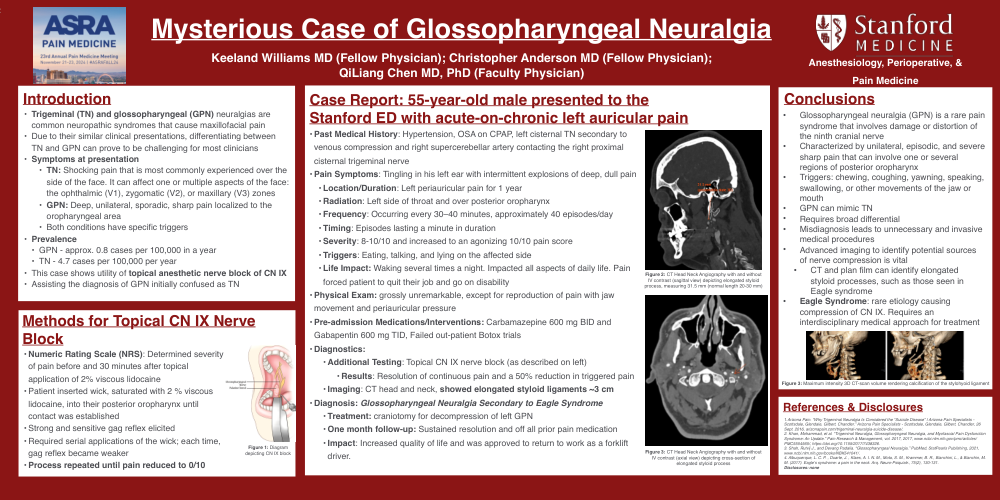
- Imaging: CT head and neck, showed elongated styloid ligaments ~3 cm
- Diagnosis: Glossopharyngeal Neuralgia Secondary to Eagle Syndrome
- Treatment: craniotomy for decompression of left GPN
- One month follow-up: Sustained resolution and off all prior pain medication
- Impact: Increased quality of life and was approved to return to work as a forklift driver
Conclusions
- Glossopharyngeal neuralgia (GPN) is a rare pain syndrome that involves damage or distortion of the ninth cranial nerve
- Characterized by unilateral, episodic, and severe sharp pain that can involve one or several regions of posterior oropharynx
- Triggers: chewing, coughing, yawning, speaking, swallowing, or other movements of the jaw or mouth
- GPN can mimic TN
- Requires broad differential
- Misdiagnosis leads to unnecessary and invasive medical procedures
- Advanced imaging to identify potential sources of nerve compression is key
- CT and plan film can identify elongated styloid processes, such as those seen in Eagle syndrome
- Eagle Syndrome: rare etiology causing compression of CN IX. Requires an interdisciplinary medical approach for treatment
References & Disclosures
1.Arizona Pain. “Why Trigeminal Neuralgia Is Considered the “Suicide Disease” | Arizona Pain Specialists - Scottsdale, Glendale, Gilbert, Chandler.” Arizona Pain Specialists - Scottsdale, Glendale, Gilbert, Chandler, 26 Sept. 2016, arizonapain.com/trigeminal-neuralgia-suicide-disease/.
2. Khan, Mohammad, et al. “Trigeminal Neuralgia, Glossopharyngeal Neuralgia, and Myofascial Pain Dysfunction Syndrome: An Update.” Pain Research & Management, vol. 2017, 2017, www.ncbi.nlm.nih.gov/pmc/articles/PMC5554565/, https://doi.org/10.1155/2017/7438326.
3. Shah, Rutvij J., and Devang Padalia. “Glossopharyngeal Neuralgia.” PubMed, StatPearls Publishing, 2021, www.ncbi.nlm.nih.gov/books/NBK541041/.
4. Albuquerque, L. C. P. , Duarte, J. , Klaes, A. I. N. M., Mota, S. M., Krammer, B. R., Bianchini, L., & Bianchin, M. M. (2017). Eagle’s syndrome: a pain in the neck. Arq. Neuro-Psiquiatr., 75(2), 130-131.
Disclosures: none