501 posters, 2 videos, 1 audios, 8 topics, 37 sessions, 395 authors, 307 institutions
ePostersLive by SciGen Technologies S.A. All rights reserved.
23rd Annual Pain Medicine Meeting 2024
November 21-23, 2024 | Caesars Palace, Las Vegas, Nevada

6190
SPINAL CORD STIMULATION USAGE IN TREATING CHRONIC POSTOPERATIVE ABDOMINAL PAIN
Poster Presenter
Authors
Affiliations
Part of Topic
Medically Challenging Cases
Abstract Title: Spinal Cord Stimulation usage in treating Chronic postoperative abdominal pain
Introduction
Chronic postoperative abdominal pain (CPAP) significantly affects patients' lives, occurring in approximately 11% of abdominal surgeries. This condition is associated with increased gastrointestinal symptoms and decreased overall quality of life. Surgeries commonly linked to CPAP include cholecystectomy, herniorrhaphy, adhesiolysis, and thoracotomy. Surgical stoma’s are another common procedure that are linked with chronic pain outcomes. The creation of a stoma results in a permanent defect in the abdominal wall, raising concerns about its potential impact on core stability and the increased risk of low back pain in individuals with a stoma. Current treatment options such as pharmaceutical management, nerve blocks, and radiofrequency procedures, often fail to provide lasting pain relief. Emerging research suggests that spinal cord stimulation (SCS) may be effective in managing visceral abdominal and pelvic pain caused by repeated distension and hyperalgesia. Previous small case series have shown that SCS can improve pain scores, enhance functional capacity, and reduce opioid use in patients with abdominal and pelvic visceral pain. Thus, we present a case of a female patient with a history of multiple abdominal surgeries and CPAP, who experienced successful pain relief through spinal neuromodulation.
Material/Method
Patient Consent: Patient informed consent was obtained for submission of a case
Case Report
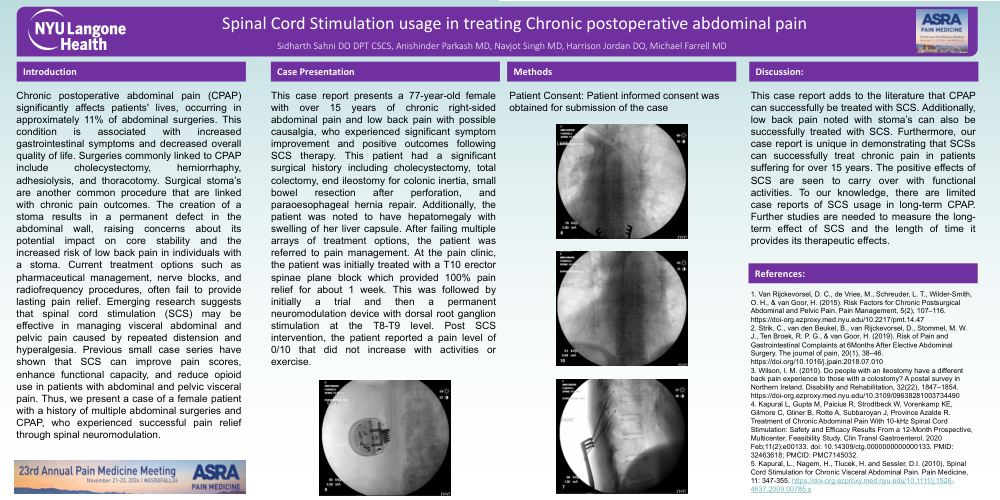
This case report presents a 77-year-old female with over 15 years of chronic right-sided abdominal pain and low back pain with possible causalgia, who experienced significant symptom improvement and positive outcomes following SCS therapy. This patient had a significant surgical history including cholecystectomy, total colectomy, end ileostomy for colonic inertia, small bowel resection after perforation, and paraoesophageal hernia repair. Additionally, the patient was noted to have hepatomegaly with swelling of her liver capsule. After failing multiple arrays of treatment options, the patient was referred to pain management. At the pain clinic, the patient was initially treated with a T10 erector spinae plane block which provided 100% pain relief for about 1 week. This was followed by initially a trial and then a permanent neuromodulation device with dorsal root ganglion stimulation at the T8-T9 level. Post SCS intervention, the patient reported a pain level of 0/10 that did not increase with activities or exercise.
Discussion
This case report adds to the literature that CPAP can successfully be treated with SCS. Additionally, low back pain noted with stoma’s can also be successfully treated with SCS. Furthermore, our case report is unique in demonstrating that SCSs can successfully treat chronic pain in patients suffering for over 15 years. The positive effects of SCS are seen to carry over with functional activities. To our knowledge, there are limited case reports of SCS usage in long-term CPAP. Further studies are needed to measure the long-term effect of SCS and the length of time it provides its therapeutic effects.
References
- Van Rijckevorsel, D. C., de Vries, M., Schreuder, L. T., Wilder-Smith, O. H., & van Goor, H. (2015). Risk Factors for Chronic Postsurgical Abdominal and Pelvic Pain. Pain Management, 5(2), 107–116. https://doi-org.ezproxy.med.nyu.edu/10.2217/pmt.14.47
- Strik, C., van den Beukel, B., van Rijckevorsel, D., Stommel, M. W. J., Ten Broek, R. P. G., & van Goor, H. (2019). Risk of Pain and Gastrointestinal Complaints at 6Months After Elective Abdominal Surgery. The journal of pain, 20(1), 38–46. https://doi.org/10.1016/j.jpain.2018.07.010
- Wilson, I. M. (2010). Do people with an ileostomy have a different back pain experience to those with a colostomy? A postal survey in Northern Ireland. Disability and Rehabilitation, 32(22), 1847–1854. https://doi-org.ezproxy.med.nyu.edu/10.3109/09638281003734490
- Kapural L, Gupta M, Paicius R, Strodtbeck W, Vorenkamp KE, Gilmore C, Gliner B, Rotte A, Subbaroyan J, Province-Azalde R. Treatment of Chronic Abdominal Pain With 10-kHz Spinal Cord Stimulation: Safety and Efficacy Results From a 12-Month Prospective, Multicenter, Feasibility Study. Clin Transl Gastroenterol. 2020 Feb;11(2):e00133. doi: 10.14309/ctg.0000000000000133. PMID: 32463618; PMCID: PMC7145032.
- Kapural, L., Nagem, H., Tlucek, H. and Sessler, D.I. (2010), Spinal Cord Stimulation for Chronic Visceral Abdominal Pain. Pain Medicine, 11: 347-355. https://doi-org.ezproxy.med.nyu.edu/10.1111/j.1526-4637.2009.00785.x