501 posters, 2 videos, 1 audios, 8 topics, 37 sessions, 395 authors, 307 institutions
ePostersLive by SciGen Technologies S.A. All rights reserved.
23rd Annual Pain Medicine Meeting 2024
November 21-23, 2024 | Caesars Palace, Las Vegas, Nevada

6073
SPONTANEOUS RESOLUTION OF ACUTE QUADRIPARESIS FROM CERVICAL EPIDURAL HEMATOMA FOLLOWING CERVICAL EPIDURAL STEROID INJECTION
Poster Presenter
Authors
Affiliations
Part of Topic
Medically Challenging Cases
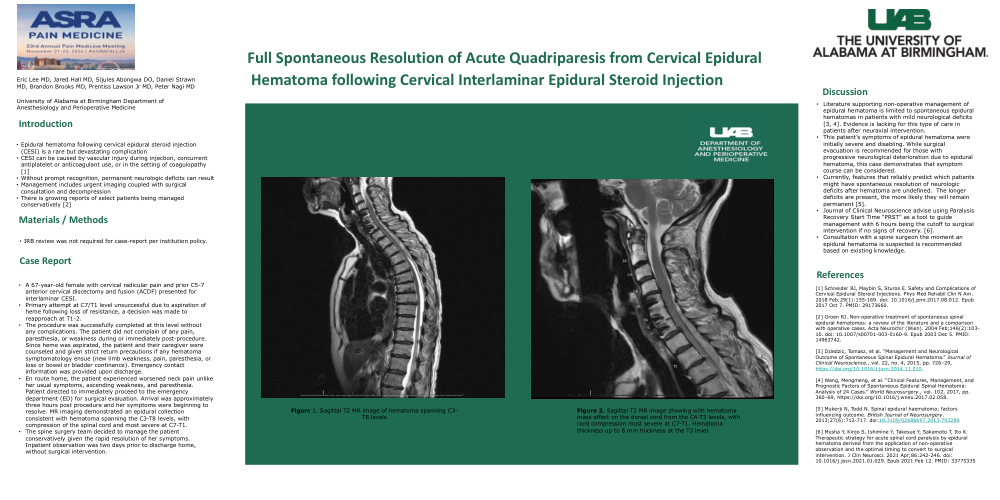
Introduction • Epidural hematoma following cervical epidural steroid injection (CESI) is a rare but devastating complication • CESI can be caused by vascular injury during injection, concurrent antiplatelet or anticoagulant use, or in the setting of coagulopathy [1] • Without prompt recognition, permanent neurologic deficits can result • Management includes urgent imaging coupled with surgical consultation and decompression • There is growing reports of select patients being managed conservatively [2] Materials / Methods Case Report • IRB review was not required for case-report per institution policy. • A 67-year-old female with cervical radicular pain and prior C5-7 anterior cervical discectomy and fusion (ACDF) presented for interlaminar CESI. • Primary attempt at C7/T1 level unsuccessful due to aspiration of heme following loss of resistance, a decision was made to reapproach at T1-2. • The procedure was successfully completed at this level without any complications. The patient did not complain of any pain, paresthesia, or weakness during or immediately post-procedure. Since heme was aspirated, the patient and their caregiver were counseled and given strict return precautions if any hematoma symptomatology ensue (new limb weakness, pain, paresthesia, or loss or bowel or bladder continence). Emergency contact information was provided upon discharge. • En route home, the patient experienced worsened neck pain unlike her usual symptoms, ascending weakness, and paresthesia. Patient directed to immediately proceed to the emergency department (ED) for surgical evaluation. Arrival was approximately three hours post procedure and her symptoms were beginning to resolve. MR imaging demonstrated an epidural collection consistent with hematoma spanning the C3-T8 levels, with compression of the spinal cord and most severe at C7-T1. • The spine surgery team decided to manage the patient conservatively given the rapid resolution of her symptoms. Inpatient observation was two days prior to discharge home, without surgical intervention.