501 posters, 2 videos, 1 audios, 8 topics, 37 sessions, 395 authors, 307 institutions
ePostersLive by SciGen Technologies S.A. All rights reserved.
23rd Annual Pain Medicine Meeting 2024
November 21-23, 2024 | Caesars Palace, Las Vegas, Nevada

6002
SPINAL CORD STIMULATION REDUCES SPASTICITY AND ENHANCES C7 MYOTOME MOTOR ACTIVATION IN AN INCOMPLETE CERVICAL SPINAL CORD INJURY
Poster Presenter
Authors
Affiliations
Part of Topic
Medically Challenging Cases
Intro:
•In the United States, there are approximately 300,000 people living with SCI, and about 17,000 new cases are reported each year with a cost of almost $10 billion annually
•Some complications, such as the motor spasticity seen in our patient, affects 65–92% of people with chronic SCI
•Spasticity typically begins to develop several weeks or months after injury and can lead to pain, discomfort, and complications with significant functional impairment
•Current treatment strategies for post-SCI spasticity involve multimodal strategies such as passive muscle stretching and physical therapy, pharmacologic agents (tizanidine, benzodiazepines, baclofen), onabotulinumtoxinA injections, or surgical interventions (e.g., dorsal rhizotomy)
•Recent literature shows that adequate pain-control and increased functionality correlates with better outcomes and quality of life (QOL)
Case Report:
•60-year-old male with a history of traumatic cervical SCI (C5 AIS D) secondary to a ski accident
•Presented to the pain management clinic with chronic spasticity and neuropathic pain of the right upper extremity (RUE) and bilateral lower extremities (BLE)
•Minimal relief with conservative management and chemodenervation with botulinum toxin
•Physical examination demonstrated increased tone in his RUE, resulting in loss of function, along with complaints of paresthesia and numbness in his BLE.
•This resulted in severe functional debility affecting his appetite, sleep, mood, activity level and overall QOL
•The patient was agreeable to trying other treatment modalities and subsequently underwent a spinal cord stimulation (SCS) trial
Outcomes:
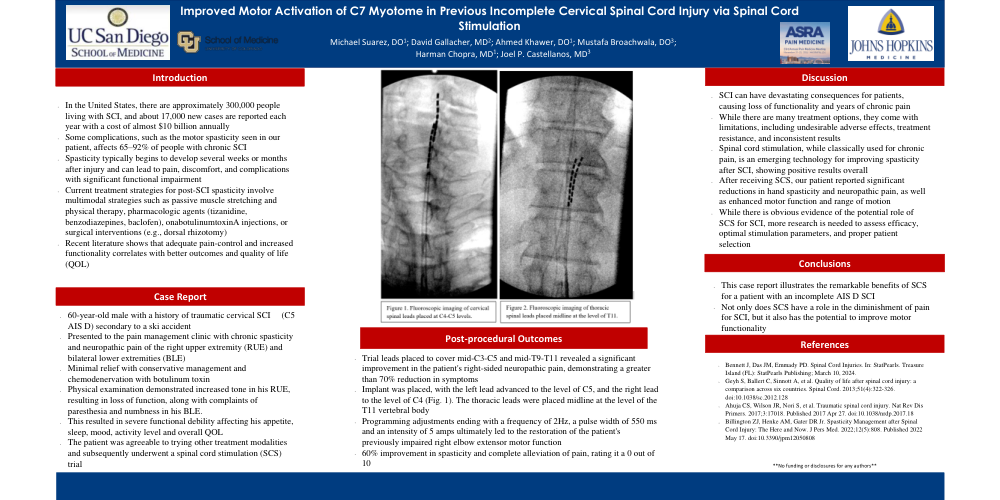
•Trial leads placed to cover mid-C3-C5 and mid-T9-T11 revealed a significant improvement in the patient's right-sided neuropathic pain, demonstrating a greater than 70% reduction in symptoms
•Implant was placed, with the left lead advanced to the level of C5, and the right lead to the level of C4 (Fig. 1). The thoracic leads were placed midline at the level of the T11 vertebral body
•Programming adjustments ending with a frequency of 2Hz, a pulse width of 550 ms and an intensity of 5 amps ultimately led to the restoration of the patient's previously impaired right elbow extensor motor function
•60% improvement in spasticity and complete alleviation of pain, rating it a 0 out of 10
Discussion:
•SCI can have devastating consequences for patients, causing loss of functionality and years of chronic pain
•While there are many treatment options, they come with limitations, including undesirable adverse effects, treatment resistance, and inconsistent results
•Spinal cord stimulation, while classically used for chronic pain, is an emerging technology for improving spasticity after SCI, showing positive results overall
•After receiving SCS, our patient reported significant reductions in hand spasticity and neuropathic pain, as well as enhanced motor function and range of motion
•While there is obvious evidence of the potential role of SCS for SCI, more research is needed to assess efficacy, optimal stimulation parameters, and proper patient selection
Conclusion:
•This case report illustrates the remarkable benefits of SCS for a patient with an incomplete AIS D SCI
•Not only does SCS have a role in the diminishment of pain for SCI, but it also has the potential to improve motor functionality