Loading...

501 posters, 2 videos, 1 audios, 8 topics, 37 sessions, 395 authors, 307 institutions

ePostersLive by SciGen Technologies S.A. All rights reserved.

23rd Annual Pain Medicine Meeting 2024

November 21-23, 2024 | Caesars Palace, Las Vegas, Nevada

23rd Annual Pain Medicine Meeting 2024 banner

5835

EFFECTIVE ANESTHETIC MANAGEMENT USING CONTINUOUS SPINAL ANESTHESIA IN A HIGH-RISK PATIENT: A CASE REPORT
Part of Topic

Medically Challenging Cases

Introduction & Background

•Intrathecal catheters are essential in modern anesthesia and pain management, enabling targeted drug delivery while minimizing systemic side effects.
 
•Advantages include stable hemodynamics, avoidance of airway manipulation, and effective pain control, all while allowing for lower medication doses in comparison to general anesthesia.
 

Case Report

•A 67-year-old male, with a BMI of 34.82 kg/m2 (1.72m and 103.9kg), ASA 4, with a past medical history of obstructive sleep apnea, cerebrovascular accident, exercise intolerance (<4 METS), hypertension, myocardial infarction, coronary artery disease, and congestive heart failure with an ejection fraction of 21% presented for a hip replacement.


•Continuous spinal anesthesia was selected due to his heart failure and obstructive sleep apnea, with informed consent obtained. The procedure involved inserting an epidural catheter at the L2-3 interspace, administering 1 ml of 0.5% bupivacaine, and monitoring blood pressure with intravenous norepinephrine support.


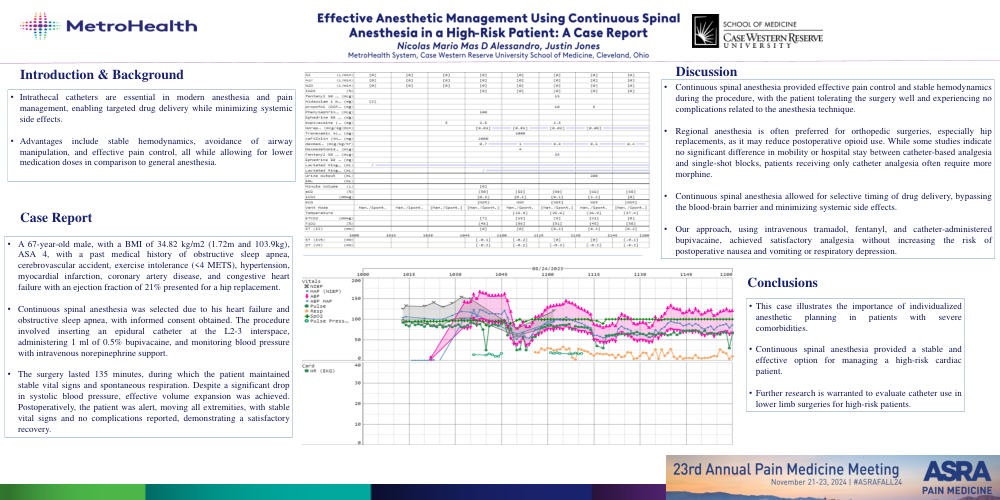
•The surgery lasted 135 minutes, during which the patient maintained stable vital signs and spontaneous respiration. Despite a significant drop in systolic blood pressure, effective volume expansion was achieved. Postoperatively, the patient was alert, moving all extremities, with stable vital signs and no complications reported, demonstrating a satisfactory recovery.
 

Discussion

Continuous spinal anesthesia provided effective pain control and stable hemodynamics during the procedure, with the patient tolerating the surgery well and experiencing no complications related to the anesthesia technique.


Regional anesthesia is often preferred for orthopedic surgeries, especially hip replacements, as it may reduce postoperative opioid use. While some studies indicate no significant difference in mobility or hospital stay between catheter-based analgesia and single-shot blocks, patients receiving only catheter analgesia often require more morphine.


Continuous spinal anesthesia allowed for selective timing of drug delivery, bypassing the blood-brain barrier and minimizing systemic side effects.


Our approach, using intravenous tramadol, fentanyl, and catheter-administered bupivacaine, achieved satisfactory analgesia without increasing the risk of postoperative nausea and vomiting or respiratory depression.


Conclusions


•This case illustrates the importance of individualized anesthetic planning in patients with severe comorbidities. Continuous spinal anesthesia provided a stable and effective option for managing a high-risk cardiac patient, emphasizing the need for careful consideration of anesthetic techniques in complex cases.
•Further research is warranted to evaluate catheter use in lower limb surgeries for high-risk patients.
23rd Annual Pain Medicine Meeting 2024 » banner
Copyright © 2015-2026, ePostersLive® SciGen is a registered trademark of SciGen Technologies S.A. Patent pending.

This website and third-party tools we use rely on cookies for the best user experience. By selecting "I agree", you agree to cookie usage as described in our Privacy Policy.