501 posters, 2 videos, 1 audios, 8 topics, 37 sessions, 395 authors, 307 institutions
ePostersLive by SciGen Technologies S.A. All rights reserved.
23rd Annual Pain Medicine Meeting 2024
November 21-23, 2024 | Caesars Palace, Las Vegas, Nevada

5826
REGIONAL FOR NONOPERATIVE PAIN: QUADRATUS LUMBORUM BLOCK FOR ULCERATIVE COLITIS FLARE
Poster Presenter
Authors
Affiliations
Part of Topic
Medically Challenging Cases
Ulcerative colitis is a chronic relapsing and remitting inflammatory bowel disease characterized by abdominal pain and bloody
diarrhea from mucosal inflammation of the rectum and colon. Acute flares are typically treated with biological therapy and pain
management. While truncal nerve blocks are routinely used as part of a multi-modal perioperative analgesic strategy, their routine
use for non-operative pain is not as prevalent.
Analgesia from truncal fascial plane blocks is achieved by local anesthetic spread between discrete fascial layers, a variety of
which are utilized in the perioperative setting. Quadratus lumborum (QL) blocks target the thoracolumbar nerves adjacent to the
quadratus lumborum muscle, providing anesthesia to the posterior abdominal wall. Transversus abdominis plane (TAP) blocks
target the ilioinguinal and iliohypogastric nerves between the internal oblique and transversus abdominis fascia. Additional fascial
plane blocks commonly utilized include the rectus sheath, serratus anterior, and erector spinae blocks.
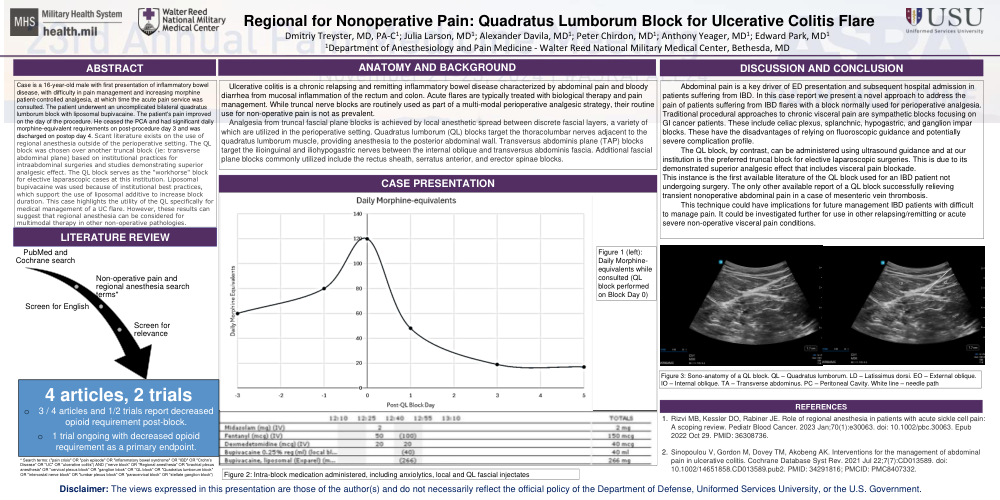
Case is a 16-year-old male with first presentation of inflammatory bowel
disease, with difficulty in pain management and increasing morphine
patient-controlled analgesia, at which time the acute pain service was
consulted. The patient underwent an uncomplicated bilateral quadratus
lumborum block with liposomal bupivacaine. The patient's pain improved
on the day of the procedure. He ceased the PCA and had significant daily
morphine-equivalent requirements on post-procedure day 3 and was
discharged on postop day 4. Scant literature exists on the use of
regional anesthesia outside of the perioperative setting. The QL
block was chosen over another truncal block (ie: transverse
abdominal plane) based on institutional practices for
intraabdominal surgeries and studies demonstrating superior
analgesic effect. The QL block serves as the "workhorse" block
for elective laparascopic cases at this institution. Liposomal
bupivacaine was used because of institutional best practices,
which support the use of liposomal additive to increase block
duration. This case highlights the utility of the QL specifically for
medical management of a UC flare. However, these results can
suggest that regional anesthesia can be considered for
multimodal therapy in other non-operative pathologies.
1. Rizvi MB, Kessler DO, Rabiner JE. Role of regional anesthesia in patients with acute sickle cell pain:
A scoping review. Pediatr Blood Cancer. 2023 Jan;70(1):e30063. doi: 10.1002/pbc.30063. Epub
2022 Oct 29. PMID: 36308736.
2. Sinopoulou V, Gordon M, Dovey TM, Akobeng AK. Interventions for the management of abdominal
pain in ulcerative colitis. Cochrane Database Syst Rev. 2021 Jul 22;7(7):CD013589. doi:
10.1002/14651858.CD013589.pub2. PMID: 34291816; PMCID: PMC8407332.
ABSTRACT ANATOMY AND BACKGROUND DISCUSSION AND CONCLUSION
CASE PRESENTATION
LITERATURE REVIEW
REFERENCES
Abdominal pain is a key driver of ED presentation and subsequent hospital admission in
patients suffering from IBD. In this case report we present a novel approach to address the
pain of patients suffering from IBD flares with a block normally used for perioperative analgesia.
Traditional procedural approaches to chronic visceral pain are sympathetic blocks focusing on
GI cancer patients. These include celiac plexus, splanchnic, hypogastric, and ganglion impar
blocks. These have the disadvantages of relying on fluoroscopic guidance and potentially
severe complication profile.
The QL block, by contrast, can be administered using ultrasound guidance and at our
institution is the preferred truncal block for elective laparoscopic surgeries. This is due to its
demonstrated superior analgesic effect that includes visceral pain blockade.
This instance is the first available literature of the QL block used for an IBD patient not
undergoing surgery. The only other available report of a QL block successfully relieving
transient nonoperative abdominal pain in a case of mesenteric vein thrombosis.
This technique could have implications for future management IBD patients with difficult
to manage pain. It could be investigated further for use in other relapsing/remitting or acute
severe non-operative visceral pain conditions.
Regional for Nonoperative Pain: Quadratus Lumborum Block for Ulcerative Colitis Flare
Dmitriy Treyster, MD, PA-C1; Julia Larson, MD1; Alexander Davila, MD1; Peter Chirdon, MD1; Anthony Yeager, MD1; Edward Park, MD1
1Department of Anesthesiology and Pain Medicine - Walter Reed National Military Medical Center, Bethesda, MD
Figure 2: Intra-block medication administered, including anxiolytics, local and QL fascial injectates
Disclaimer: The views expressed in this presentation are those of the author(s) and do not necessarily reflect the official policy of the Department of Defense, Uniformed Services University, or the U.S. Government.
4 articles, 2 trials
o 3 / 4 articles and 1/2 trials report decreased
opioid requirement post-block.
o 1 trial ongoing with decreased opioid
requirement as a primary endpoint.
PubMed and
Cochrane search
Non-operative pain and
regional anesthesia search
terms*
Screen for English
Screen for
relevance
Figure 3: Sono-anatomy of a QL block. QL – Quadratus lumborum. LD – Latissimus dorsi. EO – External oblique.
IO – Internal oblique. TA – Transverse abdominus. PC – Peritoneal Cavity. White line – needle path
* Search terms: ("pain crisis" OR "pain episode" OR "inflammatory bowel syndrome" OR "IBD" OR "Crohn’s
Disease" OR "UC" OR "ulcerative colitis") AND ("nerve block" OR "Regional anesthesia" OR "brachial plexus
anesthesia" OR "cervical plexus block" OR "ganglion block" OR "QL block" OR "Quadratus lumborum block"
OR "intercostal nerve block" OR "lumbar plexus block" OR "paracervical block" OR "stellate ganglion block")
Figure 1 (left):
Daily Morphineequivalents
while
consulted (QL
block performed
on Block Day 0)