501 posters, 2 videos, 1 audios, 8 topics, 37 sessions, 395 authors, 307 institutions
ePostersLive by SciGen Technologies S.A. All rights reserved.
23rd Annual Pain Medicine Meeting 2024
November 21-23, 2024 | Caesars Palace, Las Vegas, Nevada

6275
PHARMACOLOGIC MANAGEMENT OF A PATIENT WITH INTRATHECAL PUMP INFECTION ON NEARLY 100 ORAL MORPHINE EQUIVALENTS HOURLY
Poster Presenter
Authors
Affiliations
Part of Topic
Medically Challenging Cases
Pharmacologic Management of a Patient with Intrathecal Pump Infection on Nearly 100 Oral Morphine Equivalents Per Hour: A Case Report
Introduction
Targeted drug delivery (TDD) with Intrathecal (IT) pumps administer medications directly to the cerebrospinal fluid. Moderate to severe pain refractory to oral, transdermal, and buccal opioids is challenging to manage, especially considering the systemic and adverse effects of increasing opioid dosages. When delivered intrathecally, opioids, antispasmodics, and other agents can provide greater pain relief with fewer adverse effects. They are effective in managing many different chronic pain conditions, including cancer-related pain and severe spasticity1. When IT opioid pumps fail, it is extremely challenging to convert IT to an IV/PO regimen as there are no standard guidelines for doing so.
When delivered intrathecally, opioids, antispasmodics, and other agents can provide greater pain relief with fewer adverse effects. IT pump infection rates are relatively rare with reported infection rates ranging from <1 to 27% (median 4%), and typically occur within 2 to 4 weeks after insertion of the pump.1
Purpose
This case examines the challenges of tapering high-dose intrathecal medications and addresses safety concerns with an irreplaceable pump. It discusses the challenges of transitioning from IT to oral/IV opioids, managing withdrawal, and the need for a multimodal pain management approach.
Case Description
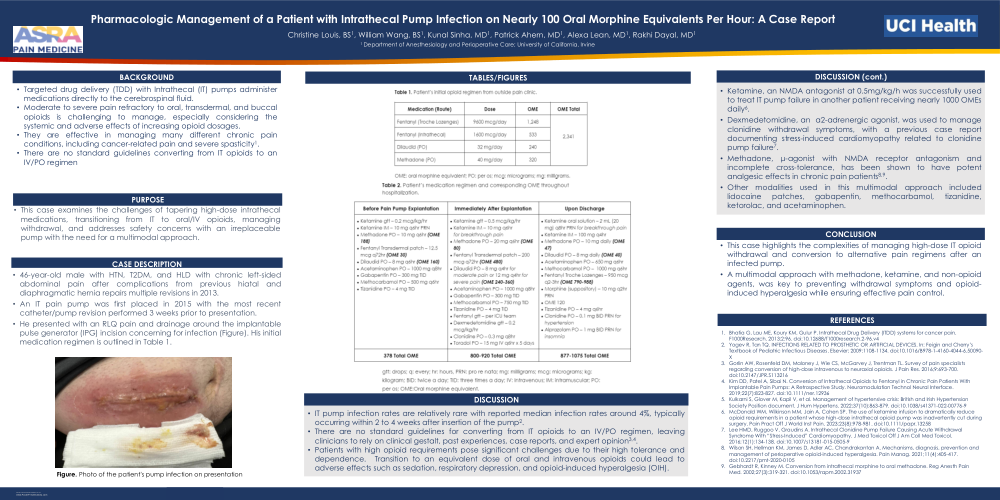
We present the case of a 46-year-old male with HTN, T2DM, and HLD with chronic left-sided abdominal pain after complications from previous hiatal/diaphragmatic hernia repairs and fundoplications with multiple revisions in 2013. An IT pain pump was first placed in 2015 with the most recent catheter/pump revision performed 3 weeks prior to presentation. He presented with an RLQ pain and drainage around the implantable pulse generator (IPG) incision concerning for infection. His initial medication regimen is outlined in Table 1.
Discussion
IT pump infection rates are relatively rare with reported median infection rates around 4%, typically occurring within 2 to 4 weeks after insertion of the pump.2 When IT opioid pumps fail, it is extremely challenging to convert IT to an IV/PO regimen as there are no standard guidelines for doing so, leaving clinicians to rely on clinical gestalt, past experiences, case reports, and expert opinion3,4. Patients with high opioid requirements on a regimen that includes IT pose significant challenges due to their high tolerance and dependence. Transition to an equivalent dose of oral and intravenous opioids could lead to adverse effects such as sedation, respiratory depression, and opioid-induced hyperalgesia (OIH). Poor pain control could also cause hypertension which was especially relevant to this patient given his history of pain-related malignant hypertension and use of IT clonidine, raising the risk of complications such as stroke, hypertensive encephalopathy, microangiopathic hemolytic anemia, and organ damage5.
The use of ketamine, an NMDA antagonist, has gained popularity as a previous case report demonstrated the efficacy of ketamine being used at 0.5mg/kg/h to treat IT pump failure in another patient receiving nearly 1000 OMEs daily6. Dexmedetomidine, an α2-adrenergic agonist, was used to manage clonidine withdrawal symptoms, with a previous case report documenting stress-induced cardiomyopathy related to clonidine pump failure7. Methadone, μ-agonist with NMDA receptor antagonism and incomplete cross-tolerance, has been shown to have potent analgesic effects in chronic pain patients8,9. Other modalities used in this multimodal approach included lidocaine patches, gabapentin, methocarbamol, tizanidine, ketorolac, and acetaminophen.