501 posters, 2 videos, 1 audios, 8 topics, 37 sessions, 395 authors, 307 institutions
ePostersLive by SciGen Technologies S.A. All rights reserved.
23rd Annual Pain Medicine Meeting 2024
November 21-23, 2024 | Caesars Palace, Las Vegas, Nevada

6001
AN UNUSUAL CASE OF REFRACTORY MERALGIA PARESTHETICA ASSOCIATED WITH SPINAL TUMOR TREATED WITH 60-DAY PERIPHERAL NERVE STIMULATION
Poster Presenter
Authors
Affiliations
Part of Topic
Medically Challenging Cases
An Unusual Case of Refractory Meralgia Paresthetica Associated with Spinal Tumor Treated with 60-day Peripheral Nerve Stimulation
Submitting/presenting author: Mushtaq H. Qureshi, MD
Department of Anesthesiology, Division of Pain Medicine, Emory University School of Medicine Mushtaq.Qureshi@emory.edu
• Introduction:
Meralgia paresthetica is a sensory neuropathy caused by entrapment of the lateral femoral cutaneous nerve (LFCN) and presents as numbness, tingling and pain in the anterolateral thigh. Typical causes of nerve entrapment include obesity, tight clothing/belts, trauma, pregnancy, and rarely pelvic mass. Lumbar spinal tumors abutting the posterior divisions of the L2 and L3 spinal nerves present an unusual etiology of meralgia paresthetica. Diagnosis is usually clinical though local anesthetic injections and electrodiagnostic studies can help confirm diagnosis. Treatment options comprise weight loss, loose clothing, neuropathic pain medications, and LFCN injection. Neuromodulation with Peripheral Nerve Stimulation (PNS) presents another therapeutic option for refractory cases.
• Materials and Methods:
Patient’s informed consent was obtained for submission of this case report, which is devoid of patient identifiable information and thus exempt from IRB review per Emory policy.
• Case Report
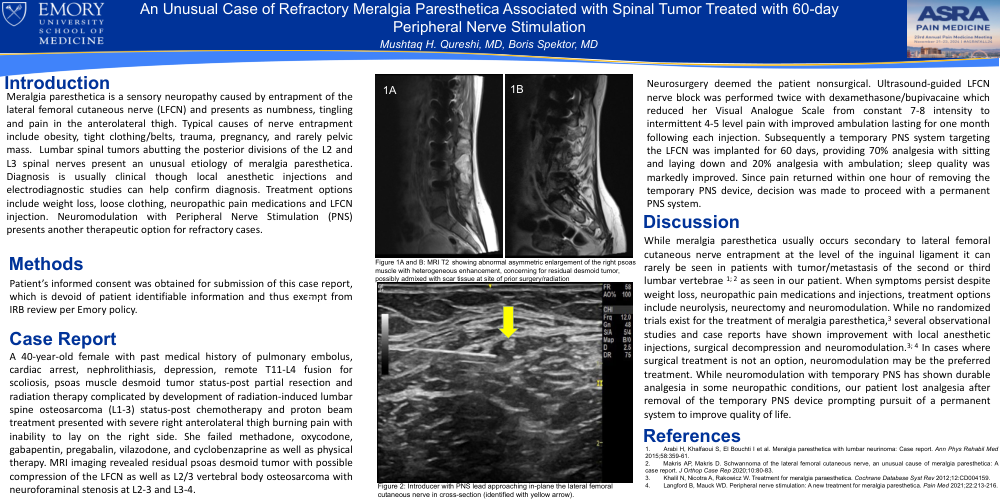
A 40-year-old female with past medical history of pulmonary embolus, cardiac arrest, nephrolithiasis, depression, remote T11-L4 fusion for scoliosis, psoas muscle desmoid tumor status-post partial resection and radiation therapy complicated by development of radiation-induced lumbar spine osteosarcoma (L1-3) status-post chemotherapy and proton beam treatment presented with severe right anterolateral thigh burning pain with inability to lay on the right side without associated weakness. She failed methadone, oxycodone, gabapentin, pregabalin, vilazodone, and cyclobenzaprine as well as physical therapy. MRI imaging revealed residual psoas desmoid tumor with possible compression of the LFCN as well as L2/3 vertebral body osteosarcoma with neuroforaminal stenosis at L2-3 and L3-4. Neurosurgery deemed the patient nonsurgical. Ultrasound-guided LFCN nerve block was performed twice with dexamethasone/bupivacaine which reduced her Visual Analogue Scale from constant 7-8 intensity to intermittent 4-5 level pain with improved ambulation lasting for one month following each injection. Subsequently a temporary PNS system targeting the LFCN was implanted for 60 days, providing 70% analgesia with sitting and laying down and 20% analgesia with ambulation; sleep quality was markedly improved. Since pain returned within one hour of removing the temporary PNS device, decision was made to proceed with a permanent PNS system.
• Discussion
While meralgia paresthetica usually occurs secondary to lateral femoral cutaneous nerve entrapment at the level of the inguinal ligament it can rarely be seen in patients with tumor/metastasis of the second or third lumbar vertebrae 1; 2 as seen in our patient. When symptoms persist despite weight loss, neuropathic pain medications and injections, treatment options include neurolysis, neurectomy and neuromodulation. While no randomized trials exist for the treatment of meralgia paresthetica,3 several observational studies and case reports have shown improvement with local anesthetic injections, surgical decompression and neuromodulation.3; 4 In cases where surgical treatment is not an option, neuromodulation may be the preferred treatment. While neuromodulation with temporary PNS has shown durable analgesia in some neuropathic conditions, our patient lost analgesia after removal of the temporary PNS device prompting pursuit of a permanent system to improve quality of life.
• Figure legend
Figure 1: Introducer with PNS lead approaching in-plane the lateral femoral cutaneous nerve in cross-section (identified with blue arrow).
• References
1. Arabi H, Khalfaoui S, El Bouchti I et al. Meralgia paresthetica with lumbar neurinoma: Case report. Ann Phys Rehabil Med 2015;58:359-61.
2. Makris AP, Makris D. Schwannoma of the lateral femoral cutaneous nerve, an unusual cause of meralgia paresthetica: A case report. J Orthop Case Rep 2020;10:80-83.
3. Khalil N, Nicotra A, Rakowicz W. Treatment for meralgia paraesthetica. Cochrane Database Syst Rev 2012;12:CD004159.
4. Langford B, Mauck WD. Peripheral nerve stimulation: A new treatment for meralgia paresthetica. Pain Med 2021;22:213-216.