501 posters, 2 videos, 1 audios, 8 topics, 37 sessions, 395 authors, 307 institutions
ePostersLive by SciGen Technologies S.A. All rights reserved.
23rd Annual Pain Medicine Meeting 2024
November 21-23, 2024 | Caesars Palace, Las Vegas, Nevada

5804
PERIPHERAL NERVE STIMULATION OF THE PHRENIC NERVE ADEQUATELY TREATS CHRONIC, INTRACTABLE HICCUPS
Poster Presenter
Authors
Affiliations
Part of Topic
Medically Challenging Cases
David S. Jevotovsky MD, MBA1
, Michael Suarez DO2
, Harman Chopra MD2
, Bryan J. Marascalchi MD3
1NYU Langone Health
2Johns Hopkins University School of Medicine
3Vanderbilt University Medical Center
Department of
Rehabilitation Medicine
Rusk Rehabilitation
Peripheral Nerve Stimulation of the Phrenic Nerve for Intractable Hiccups:
A Novel Use Case Report
INTRODUCTION
- Intractable hiccups cause significant morbidity
- Hiccup management frequently presents a significant
clinical challenge, requiring innovative approaches
beyond conventional treatments.
- Emerging studies have indicated the moderate efficacy
interventional techniques.
- This case report details the novel use of phrenic nerve
peripheral neuromodulation in the management of a
patient w ith intractable hiccups, highlighting its
relevance to both clinical practice and the scientific
community due to the condition's rarity and the
procedure's pioneering nature.
METHODS
- 73-year-old African American male presented w ith
intractable hiccups
- Hindered his ability to eat, severely impaired his speech,
and disrupted his sleep, allow ing only 2-3 hours of rest
at a time.
- Conservative therapy, phrenic nerve and stellate
ganglion blocks, and external vagal nerve stimulation
w ere ineffective.
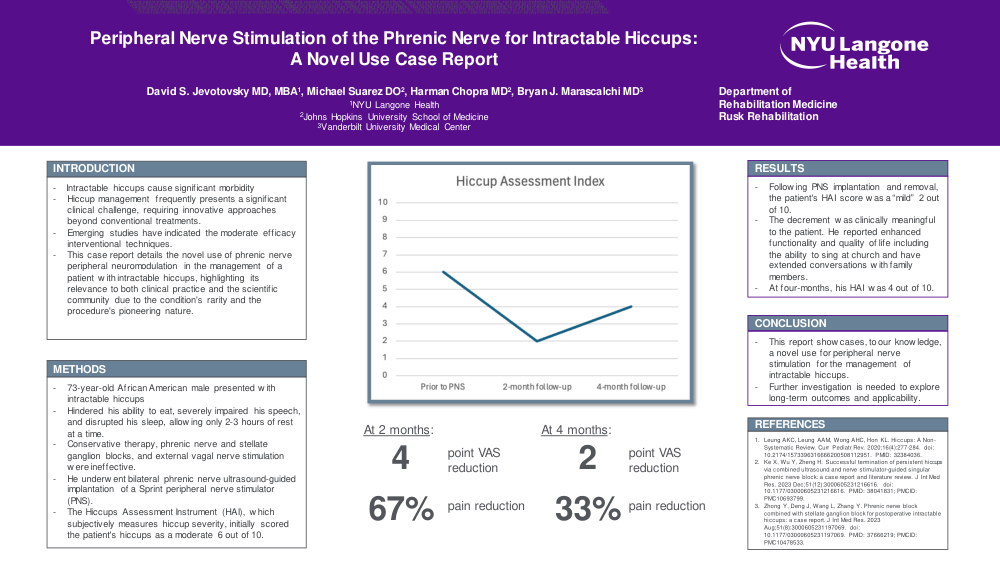
- He underw ent bilateral phrenic nerve ultrasound-guided
implantation of a Sprint peripheral nerve stimulator
(PNS).
- The Hiccups Assessment Instrument (HAI), w hich
subjectively measures hiccup severity, initially scored
the patient's hiccups as a moderate 6 out of 10.
RESULTS
- Follow ing PNS implantation and removal,
the patient's HAI score w as a “mild” 2 out
of 10.
- The decrement w as clinically meaningful
to the patient. He reported enhanced
functionality and quality of life including
the ability to sing at church and have
extended conversations w ith family
members.
- At four-months, his HAI w as 4 out of 10.
CONCLUSION
- This report show cases, to our know ledge,
a novel use for peripheral nerve
stimulation for the management of
intractable hiccups.
- Further investigation is needed to explore
long-term outcomes and applicability.