501 posters, 2 videos, 1 audios, 8 topics, 37 sessions, 395 authors, 307 institutions
ePostersLive by SciGen Technologies S.A. All rights reserved.
23rd Annual Pain Medicine Meeting 2024
November 21-23, 2024 | Caesars Palace, Las Vegas, Nevada

6168
SPINAL CORD INJURY FOLLOWING COMBINED SPINAL EPIDURAL FOR HIP ARTHROSCOPY
Poster Presenter
Part of Topic
Medically Challenging Cases
Spinal Cord Injury Following Combined Spinal Epidural for Hip Arthroscopy
A Case Study
Jeremy M. Huff, DO, FASA ● ZvonimirBebic, MD ● Marisa Sharkey, DO, FASA
INTRODUCTION:
Spinal Cord Injury following neuraxial analgesia is rare yet presents patients and anesthesiologists with devastating consequences.
CASE INFORMATION:
A 16-year-old female presents for left hip arthroscopy/labral repair
Combined Spinal Epidural technique chosen
Anesthesiologist assesses L3-L4 level and performs CSE
No CSF or heme on Touhy placement
Positive CSF on spinal needle placement
No pain or paresthesia on injection of spinal dose
CASE PROGRESSION:
Uneventful intra-operative course
6 hours post-spinal patient c/o severe pain
Bilateral, non-dermatomal, lower extremity radicular pain
Allodynia from knees to toes and saddle anesthesia
Transferred to a tertiary children’s hospital post-op day #3
Diagnosis of spinal cord injury secondary to injection trauma
TREATMENT AND RESULTS:
Ketamine infusion, tramadol, pregabalin, and meloxicam
Adjunctive pain psychology and physical therapy
Pain and mobility improved
Discharged after 5 days to outpatient follow-up
Continue to follow >2 years
Weaned off medications
Continued bilateral dysesthesias and hyperalgesia
Retained and intact lower extremity motor function
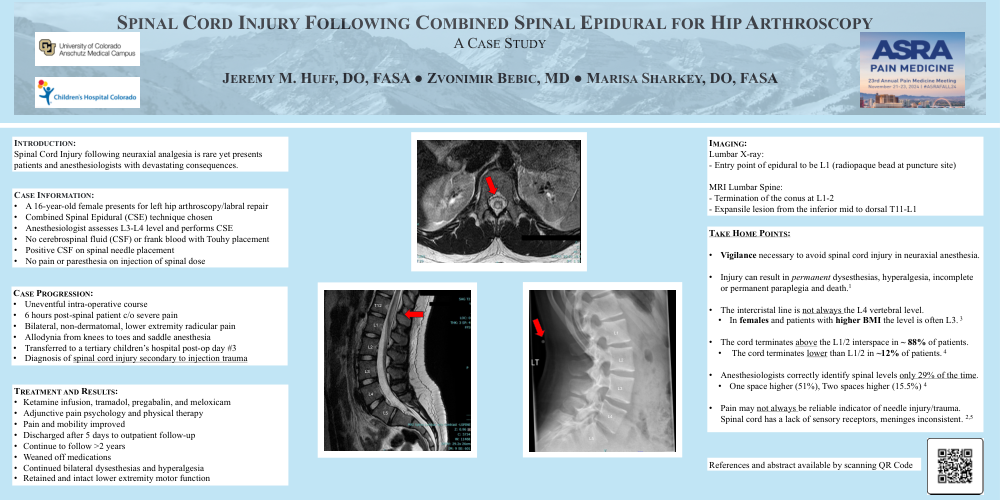
IMAGING:
Lumbar X-ray:
- Entry point of epidural to be L1 (radiopaque bead at puncture site)
MRI Lumbar Spine:
- Termination of the conus at L1-2.
- Expansile lesion from the inferior mid to dorsal T11-L1
TAKE HOME POINTS:
Vigilance necessary to avoid spinal cord injury in neuraxial anesthesia.
Injury can result in permanent dysesthesias, hyperalgesia, incomplete or permanent paraplegia and death.1
The intercristal line is not always the L4 vertebral level.
In females and patients with higher BMI the level is often L3. 3
The cord terminates above the L1/2 interspace in ~ 88% of patients.
The cord terminates lower than L1/2 in ~12% of patients. 4
Anesthesiologists correctly identify spinal levels only 29% of the time.
One space higher (51%), Two spaces higher (15.5%) 4
Pain may not always be reliable indicator of needle injury/trauma.
Spinal cord has a lack of sensory receptors, meninges inconsistent. 2,5