425 posters, 1 videos, 9 audios, 8 topics, 53 sessions, 340 authors, 286 institutions
ePostersLive by SciGen Technologies S.A. All rights reserved.
22nd Annual Pain Medicine Meeting 2023
November 10 - 11, 2023 | New Orleans Marriott | New Orleans, Louisiana, USA

4651
ENHANCING PROCEDURAL VISIT EFFICIENCY THROUGH REDUCTION OF DOCUMENTATION REDUNDANCY: A QUALITY IMPROVEMENT PROJECT
Poster Presenter
Authors
Affiliations
Part of Topic
Safety/QA/QI Projects
Enhancing Procedural Visit Efficiency Through Reduction of Documentation Redundancy: A Quality Improvement Project
Laura Delin M.D., Kenneth Brown M.D., Tiffany Pham M.D., Indraneel Prabhu D.O., Maryam Jowza M.D., Dominika James M.D.
Background:
- Procedural visit efficiency plays a crucial role in providing optimal care and maximizing patient satisfaction.
- Redundant documentation hinders workflow and impedes efficient delivery of patient-centered care.
- Studies have demonstrated that progress notes had increased in redundancy by 10.9% from 2009 to 20181, also increasing in length by 60.1%, owing much to copy-forward style writing.
- Trigger point injections (TPIs) were booked for 30 minutes clinic slots, and we hypothesized that improving efficiency would only require 15 minutes.
- This project aimed to reduce the burden of documentation in our clinic procedural suite and thereby improve efficiency.
Methods:
- The pain physicians assessed the baseline efficiency of procedural visits and existing documentation practices by interviewing staff to identify duplicative elements.
- New guidelines were established, which involved removing the need for nurses to document what physicians already were, such as medication doses/procedural steps.
- TPIs were changed from 30 minute time slots to 15 minutes, and more cases were added to determine feasibility.
- After two weeks of implementation, team members were surveyed to evaluate the impact on perceived efficiency.
- The number of TPIs and total case load before and after the intervention were analyzed.
Results:
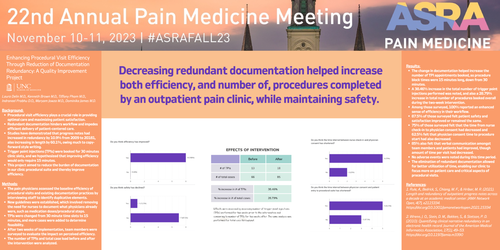
- The change in documentation helped increase the number of TPI appointments booked, as procedure block times were 15 minutes long, down from 30 minutes.
- A 38.46% increase in the total number of trigger point injections performed was noted, and also a 28.79% increase in total number of procedures booked overall during the two-week intervention.
- Among those surveyed, 100% reported an enhanced sense of efficiency in their workflow.
- 87.5% of those surveyed felt patient safety and satisfaction improved or remained the same.
- 75% of those surveyed felt that the time from nurse check-in to physician consent had decreased and 62.5% felt that physician consent time to procedure start had also decreased.
- 85% also felt that verbal communication amongst team members and patients had improved, though amount of time per visit had decreased.
- No adverse events were noted during this time period.
- The elimination of redundant documentation allowed for better utilization of time, enabling our clinic to focus more on patient care and critical aspects of procedural visits.
References:
1. Rule, A., Bedrick, S., Chiang, M. F., & Hribar, M. R. (2021). Length and redundancy of outpatient progress notes across a decade at an academic medical center. JAMA Network Open, 4(7), e2115334. https://doi.org/10.1001/jamanetworkopen.2021.15334
2. Wrenn, J. O., Stein, D. M., Bakken, S., & Stetson, P. D. (2010). Quantifying clinical narrative redundancy in an electronic health record. Journal of the American Medical Informatics Association, 17(1), 49–53. https://doi.org/10.1197/jamia.m3390