425 posters, 1 videos, 9 audios, 8 topics, 53 sessions, 340 authors, 286 institutions
ePostersLive by SciGen Technologies S.A. All rights reserved.
22nd Annual Pain Medicine Meeting 2023
November 10 - 11, 2023 | New Orleans Marriott | New Orleans, Louisiana, USA

4534
STAND UP FROM PRONE! AN EASIER AND MORE EFFICIENT PATIENT MOBILITY AFTER A BACK PROCEDURE.
Poster Presenter
Authors
Affiliations
Part of Topic
Safety/QA/QI Projects
Stand up from prone! An easier and more efficient patient mobility after a back procedure.
Yoshio Tatsuoka MD1, Sokpoleak So, MD1,2
1Yale School of Medicine, Department of Anesthesiology, New Haven, CT
2VA Connecticut Healthcare, Department of Anesthesiology, West Haven, CT
INTRODUCTION
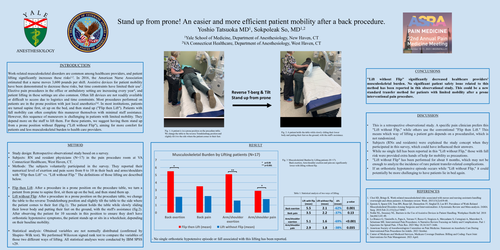
Work-related musculoskeletal disorders are common among healthcare providers, and patient lifting significantly increases these risks1,2. In 2016, the American Nurse Association estimated that a nurse moves 3,600 pounds per shift. Assistive devices for patient mobility have been demonstrated to decrease these risks, but time constraints have limited their use3. Elective pain procedures in the office or ambulatory setting are increasing every year4, and patient lifting in these settings are also common. Often lift devices are not readily available or difficult to access due to logistics and time constraints. Most procedures performed on patients are in the prone position with just local anesthetics5,6. In most institutions, patients are turned supine first, sit up on the bed, and then stand up ("Flip then Lift"). Patients with full mobility can often complete this maneuver themselves with minimal staff assistance. However, this sequence of maneuvers is challenging in patients with limited mobility. They depend more on the staff to lift them. For these patients, we suggest having them stand up from a prone position without flipping ("Lift without Flip"), aiming for more comfort for patients and less musculoskeletal burden to health care providers.
METHOD
RESULT
See figures and tables
CONCLUSIONS
"Lift without Flip" significantly decreased healthcare providers' musculoskeletal burden. No significant patient safety issue related to this method has been reported in this observational study. This could be a new standard transfer method for patients with limited mobility after a prone interventional pain procedure.
DISCUSSION