425 posters, 1 videos, 9 audios, 8 topics, 53 sessions, 340 authors, 286 institutions
ePostersLive by SciGen Technologies S.A. All rights reserved.
22nd Annual Pain Medicine Meeting 2023
November 10 - 11, 2023 | New Orleans Marriott | New Orleans, Louisiana, USA

5022
FORMATION OF A PAIN COMMITTEE DECREASES EMERGENCY ROOM (ER) VISITS IN A RURAL CRITICAL ACCESS HOSPITAL
Poster Presenter
Authors
Affiliations
Part of Topic
Safety/QA/QI Projects
Formation of a pain committee decreases Emergency Room (ER) visits in a rural critical access hospital
Jamie Roper DO and Srinivas Pyati MD
Department of Anesthesiology, Duke University Medical Center
Durham Veterans Administration Medical Center, Durham, NC 27710, USA
In our critical access hospital, we had many patients that were frequenting the ER seeking opiates chronic pain issues. These patients were often getting IV narcotics in the ER and occasionally take-home narcotics if presenting outside of open pharmacy hours. Opiate use is a major problem in the US (1), and while state PMPs have made out-patient opiate prescribing visible and trackable – opiates given in ER are not tracked. It has been well established that narcotics are best managed by a sole provider (2). We developed a multidisciplinary pain committee team to track and develop care plans for these individuals.
The pain committee consisted of local emergency medicine (EM) physicians, palliative care physicians, pain management physicians, hospital pharmacists, the EM nurse director, the clinical informatics coordinator, and an administrative assistant. Patients were referred to the pain committee by EM nurses or physicians based on frequent ER visits requiring opiates. Old and new referrals were reviewed monthly. Each month we reviewed the referral’s number of ER visits over the past month, ER opiate requirements, narcotics prescribed each visit, and their monthly opiate use based on PMP aware. The referral past medical history was reviewed and we develop opiate sparing recommendations for management of their pain in the ER (emergency room). Our informatic coordinator enabled us to flag patients to let all providers and nurses know they were on pain committee and to see our recommendations for first line pain control. Providers could choose not to follow our recommendation without repercussion. Monthly recommendations were sent out to all ER providers.
The decreased ER visits shows that a multidisciplinary committee for "frequent fliers" to the ER is a good approach in the rural setting, where patients may have a lack of access or resources for their chronic pain complaints. The reason for decreased ER visits is likely multifactorial. Likely a combination of better recognition of frequent visits, better outpatient follow-up when possible, and less opiate use giving patients less incentive to go to the ER for chronic issues.
Many emergency rooms have a high burn out and turnover rate for both physician and nurses (3,4). Additionally rural sites often have physicians that come in from the city a few days months to help-out. New and less frequent employees allows frequent ER users to go unrecognized. Pain management physicians and ER physicians that are managing chronic pain patients may be unaware of the frequency of their patients’ ER visits and potential opiate misuse. Having informatics work with the EMR to develop a way to flag these patients likely had a huge benefit.
Our committee worked with primary care and chronic pain management or palliative to get adequate follow-up outpatient. For example, when one patient who had been using the ER monthly, came in 8 times in one month for panic attacks and diffuse pain after a stressful life event, we discussed the increased visit frequency with their primary doctor. The primary doctor aided in adjusting anxiety medications and arranged for mental health follow-up. The patient did not return to the ER for another two months after these interventions. Another cancer patient had come to ER 2 months in row with similar stories of having their narcotics “stolen,” requesting medication through the weekend. Their pain doctor adjusted maintenance medications for better pain control and he did not return for several months. It is possible that some of our patients presented to the ER less as they had better outpatient care or better maintenance pain control. However, we do not have patient data to validate this. A patient survey in the future could be helpful.
In addition to encouraging outpatient care, we gave opiate sparing recommendations for ER pain control. Due to these recommendations, there was a huge decrease in treating this population with opiates by providers in the ER. This gave patients only seeking a high less incentive to visit the ER.
While we can show that our patients on the committee used our ER less, we do know if these patients began utilizing other emergency rooms more. More studies are needed to correlate that reduced ER visits contributed to improved pain control or better patient health. This project was done in a rural critical access hospital and may not be reproduceable at larger facilities.
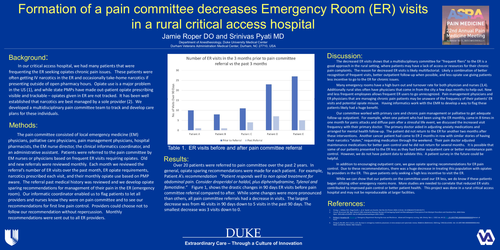
Over 20 patients were referred to pain committee over the past 2 years. In general, opiate sparing recommendations were made for each patient. For example, Patient A’s recommendation “Patient responds well to non opiod treatment for abdominal pain. Consider droperidol or haldol, plus diphenhydramine, Tylenol and famotidine.” Figure 1, shows the drastic changes in 90 days ER visits before pain committee referral compared to after. While some changes were more pronounced than others, all pain committee referrals had a decrease in visits. The largest decrease was from 46 visits in 90 days down to 5 visits in the past 90 days. The smallest decrease was 3 visits down to 0.