425 posters, 1 videos, 9 audios, 8 topics, 53 sessions, 340 authors, 286 institutions
ePostersLive by SciGen Technologies S.A. All rights reserved.
22nd Annual Pain Medicine Meeting 2023
November 10 - 11, 2023 | New Orleans Marriott | New Orleans, Louisiana, USA

4778
EVALUATION OF PSYCHOSOCIAL RISK FACTORS FOR PERSISTENT OPIOID USE IN A TRAUMA PAIN CLINIC – A QUALITY IMPROVEMENT INITIATIVE
Poster Presenter
Authors
Affiliations
Part of Topic
Safety/QA/QI Projects
Evaluation of psychosocial risk factors for persistent opioid
use in trauma pain clinic – a quality improvement initiative
Sunnybrook Health Sciences Centre: level 1 American College of Surgeons
certified trauma center in Canada with over 2,000 trauma team activations/year
– Multiple concomitant injuries: orthopedic fractures, soft tissue, nerve, vascular, and
traumatic brain injuries
– Patients have prolonged intensive care unit admission, multiple surgical
procedures, therefore potential for significant and prolonged pain
– In 2021, a Trauma Recovery Clinic was established at Sunnybrook Health
Sciences, a one-of-a-kind multidisciplinary clinic focused on helping trauma
patients rehabilitate and transition to community care
– Quality improvement initiatives are exempt from IRB approval by local guidelines
– Patient intake questionnaires for clinical care in the TPC were collected for new
patient referrals between May 2021 and Oct 2022
– Patient medical records were also reviewed for additional data
– Intake questionnaire consisted of :
1. demographic information (age, social habits, employment status)
2. pain patterns (body pain diagram)
3. validated pain and function questionnaire - Brief Pain Inventory (BPI)
4. analgesic medication at discharge and use at time of TPC intake
5. history of surgical interventions
– Descriptive analyses were carried out using SAS (Version 9.4)
OBJECTIVE: Analyze characteristics of the initial patient cohort referred to the
TPC to help provide improved services for transitional pain care
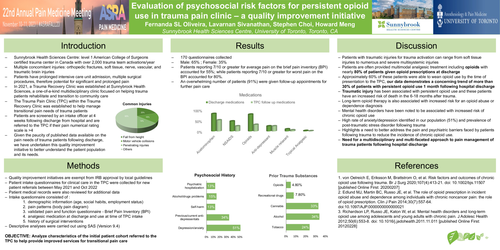
– 170 questionnaires collected
– Male: 65% ; Female: 35%
– Patients reporting 7/10 or greater for average pain on the brief pain inventory (BPI)
accounted for 55%; while patients reporting 7/10 or greater for worst pain on the
BPI accounted for 80%.
– An overwhelming number of patients (91%) were given follow-up appointments for
further pain care
24%
34%
33%
7.80%
4.80%
0% 10% 20% 30% 40%
Tobacco
Alcohol
Cannabis
Recreational drugs
Opioids
Prior Trauma Substances
51%
34%
13%
15%
13%
0% 10% 20% 30% 40% 50%
Depression/anxiety
Previous/current antidepressentats
Self-harm
Alcohol/drugs problems
Psychiatric
hospitalization
Psychosocial History
– Patients with traumatic injuries for trauma activation can range from soft tissue
injuries to numerous and severe multisystemic injuries
– Patients are often provided multimodal analgesic treatment including opioids with
nearly 80% of patients given opioid prescriptions at discharge
– Approximately 60% of these patients were able to wean opioid use by the time of
presentation to the TPC, our data demonstrates a concerning trend of more than
30% of patients with persistent opioid use 1 month following hospital discharge
– Traumatic injury has been associated with persistent opioid use and these patients
have an increased risk of death in the 6-18 months after trauma.
– Long-term opioid therapy is also associated with increased risk for an opioid abuse or
dependence diagnosis
– Mental health disorders have been noted to be associated with increased risk of
chronic opioid use
– High rate of anxiety/depression identified in our population (51%) and prevalence of
post-traumatic stress disorder following trauma
– Highlights a need to better address the pain and psychiatric barriers faced by patients
following trauma to reduce the incidence of chronic opioid use.
– Need for a multidisciplinary and multi-faceted approach to pain management of
trauma patients following hospital discharge
1. von Oelreich E, Eriksson M, Brattstrom O, et al. Risk factors and outcomes of chronic
opioid use following trauma. Br J Surg 2020;107(4):413-21. doi: 10.1002/bjs.11507
[published Online First: 20200207]
2. Edlund MJ, Martin BC, Russo JE, et al. The role of opioid prescription in incident
opioid abuse and dependence among individuals with chronic noncancer pain: the role
of opioid prescription. Clin J Pain 2014;30(7):557-64.
doi:10.1097/AJP.0000000000000021
3. Richardson LP, Russo JE, Katon W, et al. Mental health disorders and long-term
opioid use among adolescents and young adults with chronic pain. J Adolesc Health
2012;50(6):553-8. doi: 10.1016/j.jadohealth.2011.11.011 [published Online First:
20120228]
– The Trauma Pain Clinic (TPC) within the Trauma
Recovery Clinic was established to help manage
transitional pain needs of trauma patients
– Patients are screened by an intake officer at 4
weeks following discharge from hospital and are
referred to the TPC if their pain numerical rating
scale is >4
– Given the paucity of published data available on the
pain needs of trauma patients following discharge,
we have undertaken this quality improvement
initiative to better understand the patient population
and its needs.