126 posters, 2 topics, 27 sessions, 324 authors, 82 institutions
ePostersLive by SciGen Technologies S.A. All rights reserved.
2025 ACP Annual Session
October 22 - 25, 2025 | New Orleans, US

99
The effect of common denture cleaners on the microhardness, color, translucency, flexural strength and modulus of a 3D-printed denture base resin containing zirconium oxide nanoparticles.
Poster Presenter
Part of Topic
Original Research
Introduction
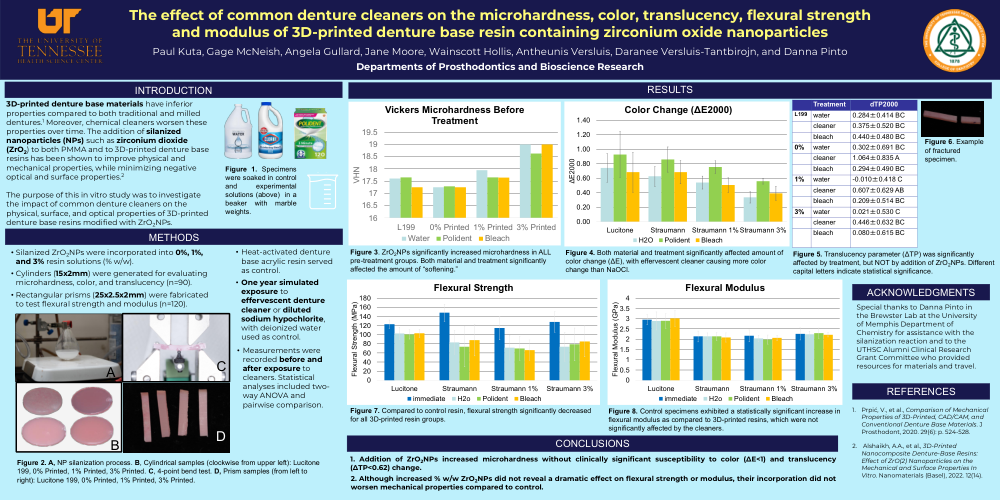
3D-printed denture base materials have inferior properties compared to both traditional and milled dentures.1 Moreover, chemical cleaners worsen these properties over time. The addition of silanized nanoparticles (NPs) such as zirconium dioxide (ZrO2) to both PMMA and to 3D-printed denture base resins has been shown to improve physical and mechanical properties, while minimizing negative optical and surface properties.2
The purpose of this in vitro study was to investigate the impact of common denture cleaners on the physical, surface, and optical properties of 3D-printed denture base resins modified with ZrO2NPs.
Methods
Silanized ZrO2NPs were incorporated into 0%, 1%, and 3% resin solutions (% w/w). Cylinders (15x2mm) were generated for evaluating microhardness, color, and translucency (n=90). Rectangular prisms (25x2.5x2mm) were fabricated to test flexural strength and modulus (n=120). Heat-activated denture base acrylic resin served as control. One year simulated exposure to effervescent denture cleaner or diluted sodium hypochlorite, with deionized water used as control. Measurements were recorded before and after exposure to cleaners. Statistical analyses included two-way ANOVA and pairwise comparison.
1. Addition of ZrO2NPs increased microhardness without clinically significant susceptibility to color (ΔE<1) and translucency (ΔTP<0.62) change.
2. Although increased % w/w ZrO2NPs did not reveal a dramatic effect on flexural strength or modulus, their incorporation did not worsen mechanical properties compared to control.
References