126 posters, 2 topics, 27 sessions, 324 authors, 82 institutions
ePostersLive by SciGen Technologies S.A. All rights reserved.
2025 ACP Annual Session
October 22 - 25, 2025 | New Orleans, US

91
Fracture Strength of Cantilevered Zirconia Superstructures of Varying Heights on Titanium Frameworks in Full-Arch Fixed Complete Dentures: An In Vitro Study
Poster Presenter
Authors
Affiliations
Part of Topic
Original Research
Optimizing Strength in Full-Arch Restorations:Various Height for Cantilevered Zirconia onTitanium Frameworks - AnInVitroStudy
Dr. Farid Sharifi , D.D.S1,Dr. Carmen Cuello, D.D.S M.S1,,Dr. Wenchou Wu, D.D.S , M.S1,Dr. Luiz Andrea Pimenta, DDS, MS, PhD, MBA1
Division of prosthodontics, College of Dental Medicine, Columbia University
ABSTRACT
Zirconia full-arch fixed complete dentures are increasingly favored for the rehabilitation of edentulous patients due to their mechanical strength and esthetic qualities. Nonetheless, concerns persist regarding the risk of fracture, particularly in cases where restorative space is limited. This in vitro study investigated the compressive fracture resistance of zirconia superstructures with different occlusal-cervical heights (2mm, 4mm, and 6mm) when supported by rigid titanium frameworks with cantilever extensions.
INTRODUCTION
Dental implants have transformed prosthodontics by enabling predictable long-term rehabilitation of edentulous patients. Among available options, full-arch zirconia prostheses supported by titanium frameworks (Ti) are increasingly popular due to their esthetics, strength, and biocompatibility. The bilayer design—zirconia bonded to Ti enhances force distribution and protects against ceramic fracture compared to monolithic zirconia. Titanium provides excellent mechanical support, while zirconia offers durability and low bacterial adhesion. Despite these advantages, zirconia remains vulnerable under tensile and shear stresses, particularly in cantilevered designs. Current in vitro studies often simplify loading and geometry, limiting clinical relevance. While factors such as Ti-base height and cement type have been studied, little is known about how zirconia height influences structural performance. This study evaluates the load-to- fracture behavior of zirconia superstructures of varying occlusal–cervical heights (2 mm, 4 mm, 6 mm) bonded to Ti frameworks with cantilevers, aiming to provide baseline data for future clinically relevant research.
METHODS
Experimental Setup
Universal testing machine (Columbia University, Carleton Lab). Custom low-carbon steel base fabricated to simulate implant fixation.
Base scanned with 3Shape E4 Lab Scanner → STL files generated for CAD/CAM design.
Sample Preparation
Multi-unit implant replicas mounted on steel base.
Zirconia superstructures (2, 4, 6 mm heights) + titanium frameworks milled via CAD/CAM. All zirconia: 35 mm L × 10 mm W, Ti base: 35 × 10 mm with 6 × 4 mm vertical strut.
10 mm distal cantilever included to mimic clinical scenario.10 specimens per group (power analysis α = 0.05, power = 80%
Bonding Protocol
Fit checked; surfaces abraded with 50 µm alumina, ultrasonically cleaned. Clearfil Ceramic Primer + Panavia V5 resin cement used.
Superstructures screw-retained (15 Ncm torque).
Testing Protocol
Vertical monotonic loading (1 mm/min) at cantilever midpoint (5 mm from distal end).
Load-to-fracture defined when force dropped to 50% of peak.
Limitations: no lateral/cyclic loading, simplified geometry.
Statistical Analysis
One-way ANOVA (SAS 9.4).
Post-fracture: Keyence VHX-5000 microscope (50×) for failure documentation.
RESULTS
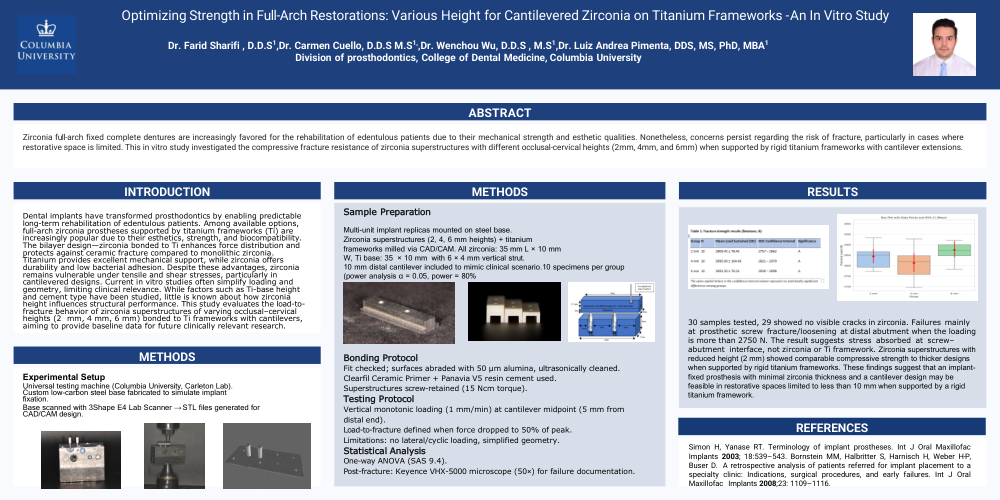
30 samples tested, 29 showed no visible cracks in zirconia. Failures mainly at prosthetic screw fracture/loosening at distal abutment when the loading is more than 2750 N. The result suggests stress absorbed at screw–abutment interface, not zirconia or Ti framework. Zirconia superstructures with reduced height (2 mm) showed comparable compressive strength to thicker designs when supported by rigid titanium frameworks. These findings suggest that an implant-fixed prosthesis with minimal zirconia thickness and a cantilever design may be feasible in restorative spaces limited to less than 10 mm when supported by a rigid titanium framework.
REFERENCES
Simon H, Yanase RT. Terminology of implant prostheses. Int J Oral Maxillofac Implants 2003; 18:539–543. Bornstein MM, Halbritter S, Harnisch H, Weber H-P, Buser D. A retrospective analysis of patients referred for implant placement to a specialty clinic: Indications, surgical procedures, and early failures. Int J Oral Maxillofac Implants 2008;23: 1109–1116.