126 posters, 2 topics, 27 sessions, 324 authors, 82 institutions
ePostersLive by SciGen Technologies S.A. All rights reserved.
2025 ACP Annual Session
October 22 - 25, 2025 | New Orleans, US

88
Mechanical Performance and Outcomes of Direct Zirconia-to-MUA Full-Arch Prostheses: A Literature Review
Poster Presenter
Authors
Affiliations
Part of Topic
Original Research
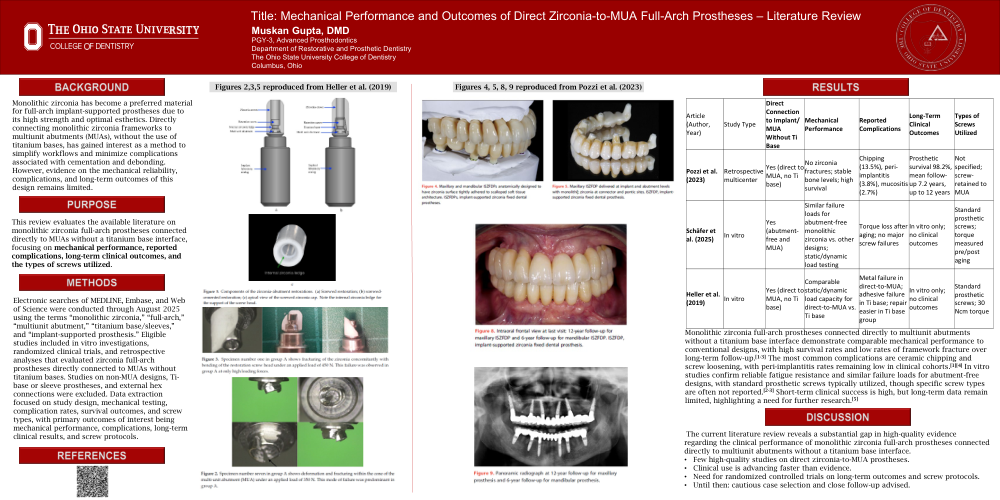
Monolithic zirconia has become a preferred material for full-arch implant-supported prostheses due to its high strength and optimal esthetics. Directly connecting monolithic zirconia frameworks to multiunit abutments (MUAs), without the use of titanium bases, has gained interest as a method to simplify workflows and minimize complications associated with cementation and debonding. However, evidence on the mechanical reliability, complications, and long-term outcomes of this design remains limited.
This review evaluates the available literature on monolithic zirconia full-arch prostheses connected directly to MUAs without a titanium base interface, focusing on mechanical performance, reported complications, long-term clinical outcomes, and the types of screws utilized.
Monolithic zirconia full-arch prostheses connected directly to multiunit abutments without a titanium base interface demonstrate comparable mechanical performance to conventional designs, with high survival rates and low rates of framework fracture over long-term follow-up.[1-3] The most common complications are ceramic chipping and screw loosening, with peri-implantitis rates remaining low in clinical cohorts.[1][4] In vitro studies confirm reliable fatigue resistance and similar failure loads for abutment-free designs, with standard prosthetic screws typically utilized, though specific screw types are often not reported.[2-3] Short-term clinical success is high, but long-term data remain limited, highlighting a need for further research.[5]
The current literature review reveals a substantial gap in high-quality evidence regarding the clinical performance of monolithic zirconia full-arch prostheses connected directly to multiunit abutments without a titanium base interface.