126 posters, 2 topics, 27 sessions, 324 authors, 82 institutions
ePostersLive by SciGen Technologies S.A. All rights reserved.
2025 ACP Annual Session
October 22 - 25, 2025 | New Orleans, US

74
Comparative Analysis of Bioelectric and Manual Toothbrushing on Surface Integrity and Wear of Acrylic Denture Teeth
Poster Presenter
Authors
Affiliations
Part of Topic
Original Research
Introduction
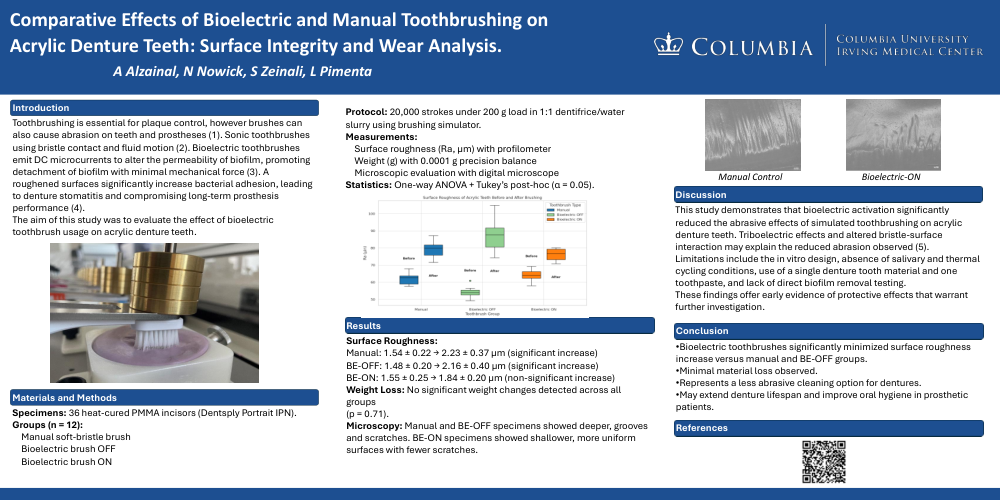
Toothbrushing is essential for plaque control, however brushes can also cause abrasion on teeth and prostheses (1). Sonic toothbrushes using bristle contact and fluid motion (2). Bioelectric toothbrushes emit DC microcurrents to alter the permeability of biofilm, promoting detachment of biofilm with minimal mechanical force (3). A roughened surfaces significantly increase bacterial adhesion, leading to denture stomatitis and compromising long-term prosthesis performance (4). The aim of this study was to evaluate the effect of bioelectric toothbrush usage on acrylic denture teeth.
Materials and Methods
Specimens: 36 heat-cured PMMA incisors (Dentsply Portrait IPN).
Groups (n = 12): Manual soft-bristle brush. Bioelectric brush OFF. Bioelectric brush ON.
Protocol: 20,000 strokes under 200 g load in 1:1 dentifrice/water slurry using brushing simulator.
Measurements: Surface roughness (Ra, µm) with profilometer. Weight (g) with 0.0001 g precision balance. Microscopic evaluation with digital microscope
Statistics: One-way ANOVA + Tukey’s post-hoc (α = 0.05).
Results
Surface Roughness:
Manual: 1.54 ± 0.22 → 2.23 ± 0.37 µm (significant increase)
BE-OFF: 1.48 ± 0.20 → 2.16 ± 0.40 µm (significant increase)
BE-ON: 1.55 ± 0.25 → 1.84 ± 0.20 µm (non-significant increase)
Weight Loss: No significant weight changes detected across all groups (p = 0.71).
Microscopy: Manual and BE-OFF specimens showed deeper, grooves and scratches. BE-ON specimens showed shallower, more uniform surfaces with fewer scratches.
Discussion
This study demonstrates that bioelectric activation significantly reduced the abrasive effects of simulated toothbrushing on acrylic denture teeth. Triboelectric effects and altered bristle-surface interaction may explain the reduced abrasion observed (5). Limitations include the in vitro design, absence of salivary and thermal cycling conditions, use of a single denture tooth material and one toothpaste, and lack of direct biofilm removal testing. These findings offer early evidence of protective effects that warrant further investigation.
Conclusion