126 posters, 2 topics, 27 sessions, 324 authors, 82 institutions
ePostersLive by SciGen Technologies S.A. All rights reserved.
2025 ACP Annual Session
October 22 - 25, 2025 | New Orleans, US

25
The Effect of Tightening Torque on Vertical Position of SRA Implant Scan Bodies
Poster Presenter
Authors
Affiliations
Part of Topic
Original Research
The Effect of Tightening Torque on Vertical Position of SRA Implant Scan Bodies
Christa Serban DMD, Osamah Alamri BDS, DMSc, Jason D. Lee DDS, MMSc
AGE Prosthodontics, Harvard School of Dental Medicine, Boston, MA
Introduction
Inconsistent tightening torque of implant scan bodies (ISBs) may cause vertical displacement and errors in implant restorations, a problem especially critical in full-arch cases where small discrepancies accumulate. Hand torquing is the most common protocol for securing ISBs and the torque achieved can vary significantly between clinicians [1, 2]. While different scan body materials and designs exist, their response to torque variation remains insufficiently studied.
Aim: To evaluate the effect of tightening torque on the vertical displacement of various screw-retained abutment (SRA) scan bodies, including titanium, PEEK, and Optisplint ISBs.
Methods
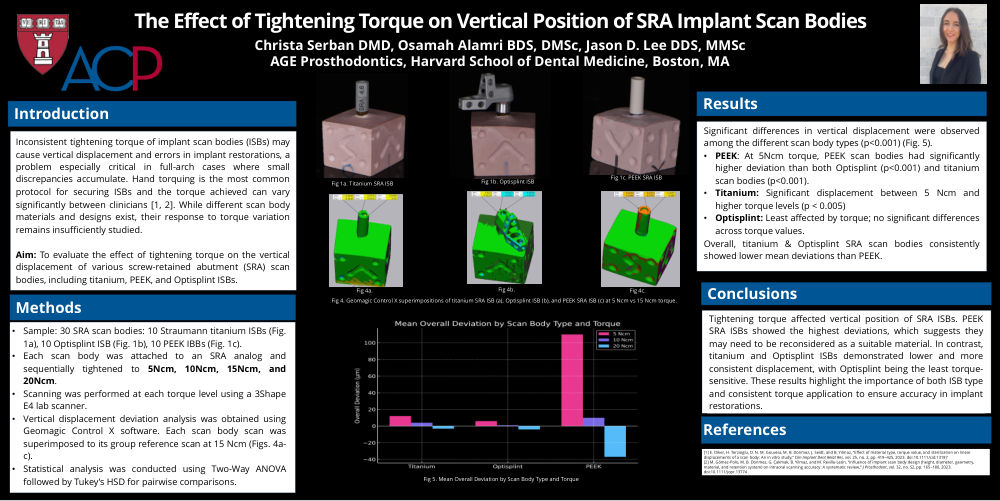
Significant differences in vertical displacement were observed among the different scan body types (p<0.001) (Fig. 5).
Overall, titanium & Optisplint SRA scan bodies consistently showed lower mean deviations than PEEK.
Conclusions
Tightening torque affected vertical position of SRA ISBs. PEEK SRA ISBs showed the highest deviations, which suggests they may need to be reconsidered as a suitable material. In contrast, titanium and Optisplint ISBs demonstrated lower and more consistent displacement, with Optisplint being the least torque-sensitive. These results highlight the importance of both ISB type and consistent torque application to ensure accuracy in implant restorations.
References
[1] E. Diker, H. Terzioglu, D. N. M. Gouveia, M. B. Donmez, J. Seidt, and B. Yilmaz, “Effect of material type, torque value, and sterilization on linear displacements of a scan body: An in vitro study,” Clin Implant Dent Relat Res, vol. 25, no. 2, pp. 419–425, 2023. doi:10.1111/cid.13187
[2] M. Gómez-Polo, M. B. Donmez, G. Çakmak, B. Yilmaz, and M. Revilla-León, “Influence of implant scan body design (height, diameter, geometry, material, and retention system) on intraoral scanning accuracy: A systematic review,” J Prosthodont, vol. 32, no. S2, pp. 165–180, 2023. doi:10.1111/jopr.13774