126 posters, 2 topics, 27 sessions, 324 authors, 82 institutions
ePostersLive by SciGen Technologies S.A. All rights reserved.
2025 ACP Annual Session
October 22 - 25, 2025 | New Orleans, US

171
Correlation Between Hunter-Schreger Band Characteristics and Dental Attrition
Poster Presenter
Authors
Affiliations
Part of Topic
Original Research
The aim of this study was to
evaluate the orientation and
number of Hunter–Schreger (HS)
bands in the incisal third of
anterior teeth, and their correlation
with the degree of tooth attrition.
Methods
This experimental study was
exempt from Institutional Review
Board (IRB) review by the Ethics
Committee of Stony Brook
University (Ref. IRB2024-00458).
Sample collection: Extracted
anterior teeth were obtained from
cadavers. Inclusion criteria
consisted of anterior teeth
presenting signs of physiological
wear, without crowns or
restorations covering the incisal
edges, and without evidence of
traumatic fractures. Exclusion
criteria included fractured teeth,
teeth with restorations involving
the incisal edges, and other signs
of crown destruction not
attributable to physiological wear.
The selection process was
conducted by a single calibrated
operator trained in identifying and
classifying the teeth according to
the inclusion and exclusion
criteria.
Grouping and wear classification: After selection based on
morphological cues, the teeth were grouped in the upper and
lower cuspids, centrals, and laterals. After grouping, the degree of
tooth wear was classified using the Gustafson’s scoring of attrition
level, were 0 indicates no presence of attrition, 1 indicates enamel
attrition, 2 indicates attrition at the level of the dentin, and a score
of 3 indicates attrition involving the pulp cavity. (Figure 1)
Results
Correlation Between Hunter-Schreger Band Characteristics and Dental Attrition: A
Pilot Study
James Clay Sheffield DDS* ,Rafael Delgado-Ruiz DDS MSc PhD, Kenneth Kurtz DDS FACP,
Tanya Somohano-Marquez DMD FACP
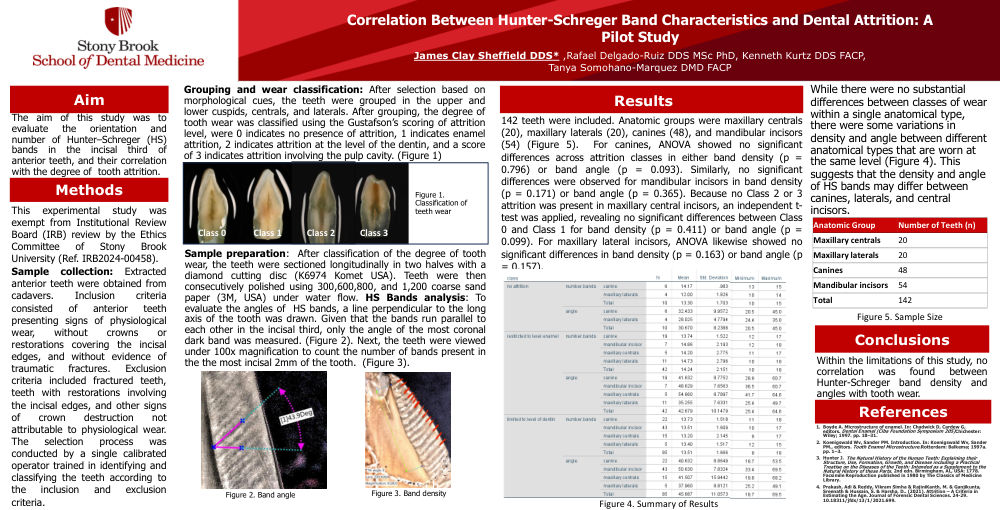
While there were no substantial
differences between classes of wear
within a single anatomical type,
there were some variations in
density and angle between different
anatomical types that are worn at
the same level (Figure 4). This
suggests that the density and angle
of HS bands may differ between
canines, laterals, and central
incisors.
Figure 1.
Classification of
teeth wear
Class 0 Class 1 Class 2 Class 3
142 teeth were included. Anatomic groups were maxillary centrals
(20), maxillary laterals (20), canines (48), and mandibular incisors
(54) (Figure 5). For canines, ANOVA showed no significant
differences across attrition classes in either band density (p =
0.796) or band angle (p = 0.093). Similarly, no significant
differences were observed for mandibular incisors in band density
(p = 0.171) or band angle (p = 0.365). Because no Class 2 or 3
attrition was present in maxillary central incisors, an independent t-
test was applied, revealing no significant differences between Class
d
0 and Class 1 for band density (p = 0.411) or band angle (p =
0.099). For maxillary lateral incisors, ANOVA likewise showed no
significant differences in band density (p = 0.163) or band angle (p
= 0.157).
Anatomic Group Number of Teeth (n)
Maxillary centrals 20
Sample preparation: After classification of the degree of tooth
wear, the teeth were sectioned longitudinally in two halves with a
diamond cutting disc (K6974 Komet USA). Teeth were then
consecutively polished using 300,600,800, and 1,200 coarse sand
paper (3M, USA) under water flow. HS Bands analysis: To
evaluate the angles of HS bands, a line perpendicular to the long
axis of the tooth was drawn. Given that the bands run parallel to
each other in the incisal third, only the angle of the most coronal
dark band was measured. (Figure 2). Next, the teeth were viewed
under 100x magnification to count the number of bands present in
the the most incisal 2mm of the tooth. (Figure 3).
Maxillary laterals 20
Canines 48
Mandibular incisors 54
Total 142
Figure 5. Sample Size
Conclusions
Within the limitations of this study, no
correlation was found between
Hunter-Schreger band density and
angles with tooth wear.