126 posters, 2 topics, 27 sessions, 324 authors, 82 institutions
ePostersLive by SciGen Technologies S.A. All rights reserved.
2025 ACP Annual Session
October 22 - 25, 2025 | New Orleans, US

167
Synthesis and Processing of a 3D-Printed Ultra-Translucent Zirconia Ink for Dental Prosthesis
Poster Presenter
Part of Topic
Original Research
Synthesis and Processing of a 3D-Printed Ultra-Translucent Zirconia Ink for Dental Prosthesis
Edmara T.P. Bergamo*1,2, Marly Valle2, Edisa Souza3, Larissa M. Alves3, Ernesto B. Benalcazar Jalkh3, Tiago M. Campos, Estevam A. Bonfante3, James E. Smay4, Leila Jahangiri1, Thomas Giugliano1, Mijin Choi1, Lukasz Witek2,5,6.
Introduction. Synthesize an ultra-translucent zirconia colloidal gel for 3D printing (3DP), designed with different layer thicknesses, and evaluate the physical and mechanical properties relative to the conventional pressed counterpart.
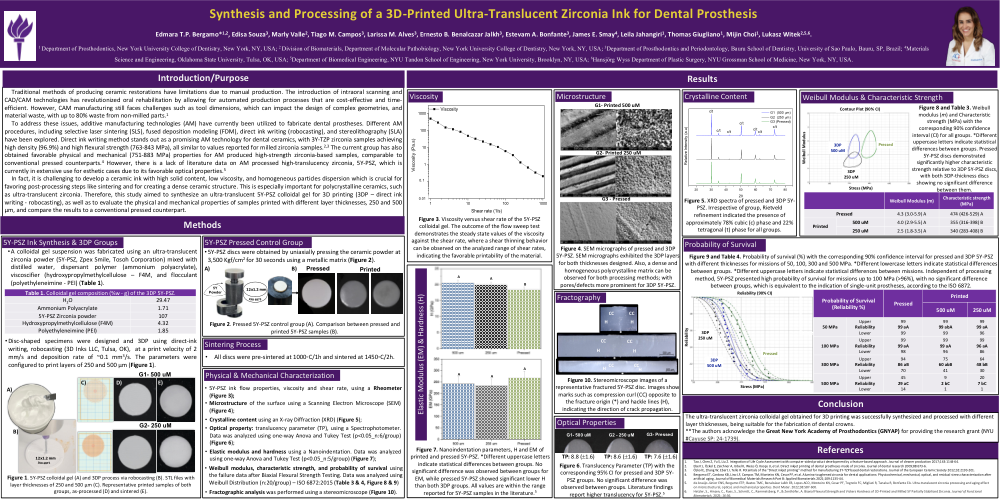
Methods. A colloidal gel suspension was fabricated using an ultra-translucent zirconia powder (5Y-PSZ, Zpex Smile, Tosoh Corporation) mixed with predetermined volumes of distilled water, dispersant polymer (ammonium polyacrylate), viscoscifier (hydroxypropylmethylcellulose, and flocculant (polyethyleneimine). Disc-shaped specimens were designed and 3DP using direct-ink writing (DIW) at a print velocity of 2 mm/s and deposition rate of ~0.1 mm3/s. The 3D-printing parameters were configured to print layers with thicknesses of 250 and 500 μm. The control group comprised of ceramic discs fabricated by uniaxially pressing powder at 3,500 Kgf/cm2 for 30 seconds using a metallic matrix. All discs were pre-sintered at 1000°C/1h and sintered at 1450°C/2h. Crystalline content was determined by X-ray diffraction (XRD) and the microstructure by scanning electron microscopy (SEM). The mechanical properties were assessed by piston-on-three-balls test to determine the flexural strength (ISO 6872:2015) and nanoindentation to determine the elastic modulus and hardness.
Results. XRD spectra showed a typical crystalline content, primarily consisting of cubic zirconia phase. SEM micrographs exhibited a dense and homogeneous polycrystalline matrix for both processing methods; however, pores/defects were more prominent for discs fabricated using the 3DP method. Weibull modulus ranged from 2.5 to 4.3 for all tested groups. Pressed zirconia discs demonstrated significantly higher characteristic strength [474 (426-529) MPa] relative to 3DP zirconia discs, with both 3DP-thickness discs showing no significant difference between them [250 μm: 340 (CI:316-398) MPa/ 500 μm: 355 (CI: 283-408) MPa]. Independent of fabrication technique (e.g., pressed or 3DP) zirconia presented high probability of survival for missions up to 100 MPa (>96%), with no significant difference between the two methods, which is equivalent to the indication of single-unit prostheses, according to the ISO 6872 requirements.
Conclusion. The results of this study demonstrate that the ultra-translucent zirconia colloidal gel obtained for 3D printing was successfully synthesized and processed with different layer thicknesses, being suitable for the fabrication of dental crowns.