126 posters, 2 topics, 27 sessions, 324 authors, 82 institutions
ePostersLive by SciGen Technologies S.A. All rights reserved.
2025 ACP Annual Session
October 22 - 25, 2025 | New Orleans, US

161
Marginal Accuracy of Zirconia Crowns: A Comparative In Vitro Study of Digital vs. Conventional Impressions
Poster Presenter
Authors
Lamar Alshamrani , Salar Zeinali, Luiz Pimenta, Wenchou(James) Wu
Affiliations
Part of Topic
Original Research
Title
Marginal Accuracy of Zirconia Crowns: A Comparative In Vitro Study of Digital vs. Conventional Impressions
Authors: A. Alshamrani, S. Zeinali, W. Wu, C. Pimenta
Columbia University College of Dental Medicine, Dept. of Prosthodontics
Introduction
Digital intraoral scanners (IOS) are increasingly replacing conventional impression techniques in fixed prosthodontics.
Polyvinyl siloxane (PVS) has long been regarded as the clinical gold standard for impression accuracy, but recent advances in intraoral scanning and CAD/CAM workflows have challenged this position.
Marginal adaptation is a critical determinant of restoration longevity, with discrepancies greater than 120 μm identified as biologically unacceptable and potentially leading to clinical failure.
Despite growing adoption of IOS, comparative evidence evaluating multiple system types in zirconia crown fabrication remains limited.
Purpose
This in vitro study sought to evaluate and compare the marginal adaptation of zirconia crowns fabricated from three different IOS systems and conventional PVS.
Groups (n=10): Trios 4, iTero 5D, Medit i500, Shining 3D Aoralscan, and PVS.
Prepared abutment dies = 3000× magnification stereomicroscope for measurements.
The null hypothesis: no significant differences would exist in the marginal adaptation among the groups.
Materials & Methods
- Sixty standardized zirconia tooth preparations assigned to 5 groups.
- Each IOS (Trios 4, iTero 5D, Medit i500, Shining 3D Aoralscan) and PVS impression technique used to fabricate monolithic zirconia crowns.
- Crowns were milled, sintered, and seated onto prepared dies.
- Marginal gaps were measured at 12 points around each crown margin using stereomicroscopy at 3000× magnification.
- Mean marginal gap values were calculated.
- Statistical analysis: Kruskal-Wallis and Wilcoxon signed-rank test (p<0.05).
Results
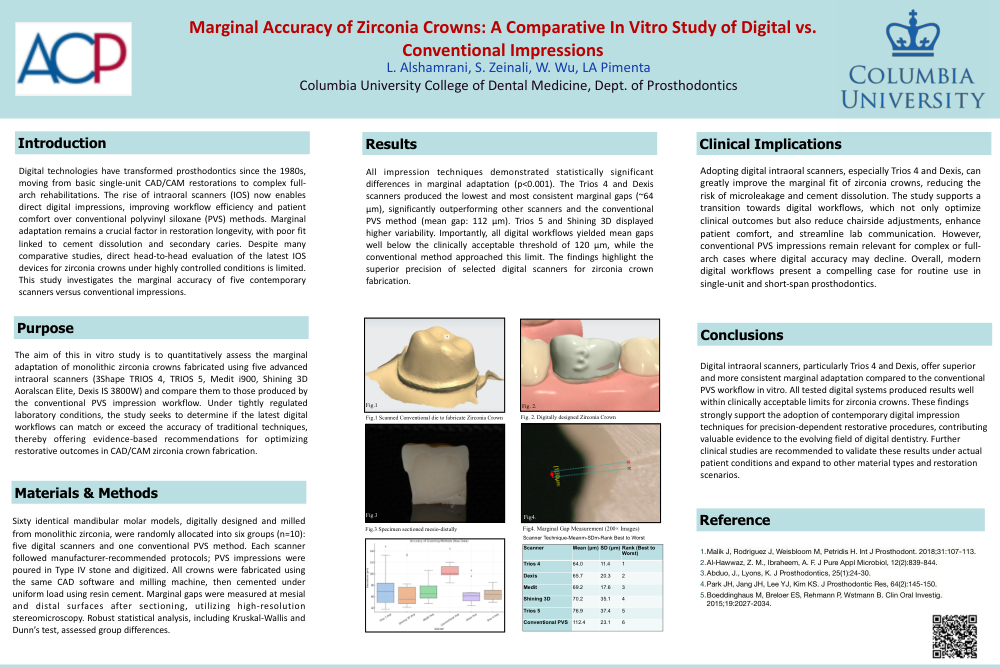
- Significant differences in marginal adaptation were observed among groups (p<0.001).
- All digital systems produced crowns with mean gaps below 120 μm, well within the 120 μm clinical threshold.
- PVS group consistently demonstrated larger mean gaps.
- iTero 5D, Trios 4 showed significantly greater adaptation than PVS.
- Medit i500, Shining 3D also yielded results within acceptable limits.
- Trios 4 and iTero 5D = most consistent outcomes.
(Figures: Microscopic gap images + Boxplot graph comparing marginal gap by impression technique.)
Clinical Implications
- Digital workflows streamline clinical and laboratory procedures, reduce chairside adjustments, and improve patient comfort.
- The superior fit of IOS crowns in this study suggests improved efficiency and long-term success.
- Despite evidence of strong performance, PVS remains relevant in full-arch and complex cases where IOS may be limited.
Conclusions
- All IOS tested produced zirconia crowns with significantly better marginal adaptation than PVS impressions.
- These findings support the widespread clinical adoption of IOS as a reliable alternative for zirconia crown fabrication.
Reference
QR code links to full reference list.