126 posters, 2 topics, 27 sessions, 324 authors, 82 institutions
ePostersLive by SciGen Technologies S.A. All rights reserved.
2025 ACP Annual Session
October 22 - 25, 2025 | New Orleans, US

157
<p>Comparison of Torque Values Between Angulated And Axial Abutment Screws: An In-Vitro Study</p> <p> </p>
Poster Presenter
Authors
Affiliations
Part of Topic
Original Research
Comparison of Torque Values Between Angulated And Axial Abutment Screws: An In-Vitro Study
Objective:
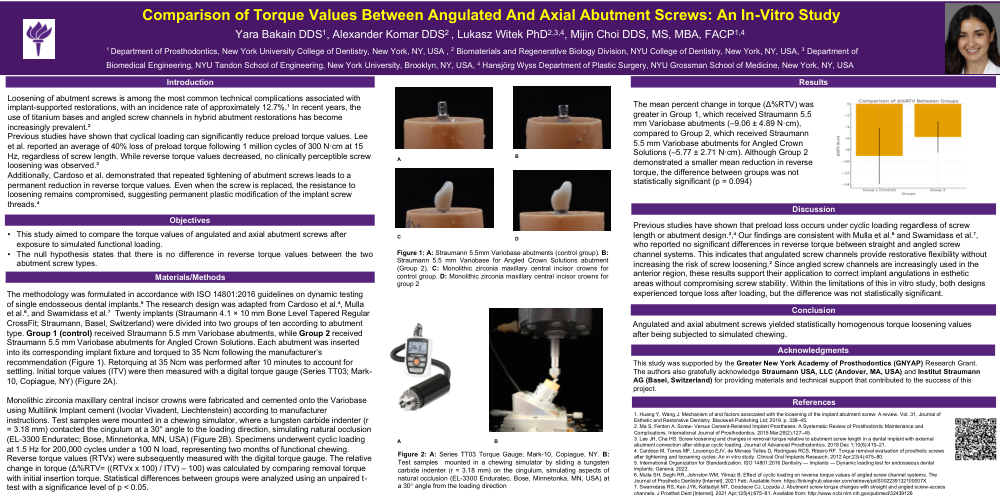
This study aimed to compare torque values of angulated and axial abutment screws after being subjected to simulated functional load. The null hypothesis is that there is no difference in reverse torque values between the abutment screw types.
Methods:
Twenty implants (4.1x10 mm, BLT RC; Straumann, Basel, Switzerland) were divided into two groups (n=10/group), according to the abutment and screw types. Group 1 (control group) implants received Straumann 5.5 mm Variobase abutments, and Group 2 (experimental) received Straumann 5.5 mm Variobase for Angled Crown Solutions abutments. Each abutment was placed into its corresponding implant fixture and torqued to 35 N⋅cm as per the manufacturer’s recommendation. 35 N⋅cm torque was repeated 10 minutes after the initial torque to account for settling. Initial torque value (ITV) was recorded at this time using a digital torque gauge (Series TT03 Torque Gauge; Mark-10, Copiague, NY). Monolithic zirconia maxillary central incisor crowns were fabricated and cemented with Ivoclar Multilink Implant cement (Ivoclar Vivadent, Liechtenstein) onto the Variobase following the manufacturer’s protocol. The test samples were mounted in a chewing simulator by sliding a tungsten carbide indenter (r = 3.18 mm) on the cingulum, simulating aspects of natural occlusion (EL-3300 Enduratec, Bose, Minnetonka, MN, USA) at a 30° angle from the loading direction. The specimens were cyclically loaded at 1.5 Hz for 200,000 cycles under a 100N load, simulating 2 months of functional loading. Reverse torque values (RTVx) were recorded using a digital torque gauge. The difference between the removal torque value relative to the initial insertion torque (Δ%RTV) was calculated. The mean data of both groups were compared using an unpaired t-test to check for statistical differences (p<0.05).
Results:
The mean (Δ%RTV) for Group 1 (the control group) was -9.06 ±4.89 N⋅cm, whereas Group 2 had a mean of -5.77 ±2.71 N⋅cm. No significant difference was observed between the groups (P=0.094).
Conclusions:
Angulated and axial abutment screws yielded statistically homogenous torque loosening values after being subjected to simulated chewing.