127 posters, 2 topics, 24 sessions, 326 authors, 85 institutions
ePostersLive by SciGen Technologies S.A. All rights reserved.
2023 ACP ANNUAL SESSION
October 25-28 | San Diego, CA

97
Fracture Strength of CAD/CAM Lithium Disilicate Partial Coverage Restorations with Various Designs
Poster Presenter
Part of Topic
Original Research
Fracture Strength of CAD/CAM Lithium Disilicate Partial Coverage Restorations with Various Designs
Joseph Molisani, DDS; Ramtin Sadid-Zadeh, DDS, MS; Akimasa Tsujimoto, DDS, PhD; Chin-Chuan Fu, DDS, MS; Carlos A. Jurado, DDS, MS
Objective
The aim of this study was to compare the fracture strength of CAD-CAM Lithium Disilicate indirect restorations with various preparation designs.
Introduction
Minimal invasive dentistry is driven by the primary objective of preserving healthy tooth structure. Advances in restorative materials and dental adhesives have paved the way for achieving this goal by minimizing the removal of natural tooth structure. This is accomplished through the application of either direct or indirect partial coverage restorations to replace lost tooth structure. (1) Advances in restorative materials and dental adhesives have paved the way for achieving this goal by minimizing the removal of natural tooth structure. This is accomplished through the application of either direct or indirect partial coverage restorations to replace lost tooth structure. (2) Occlusal veneers are thin, non-retentive indirect restorations that are securely bonded to tooth structures using modern luting agents. (3) Their primary advantage lies in their ability to restore masticatory function while simultaneously preserving precious tooth structure, all while relying on a predictable bond to the enamel. (4)
Materials and Methods
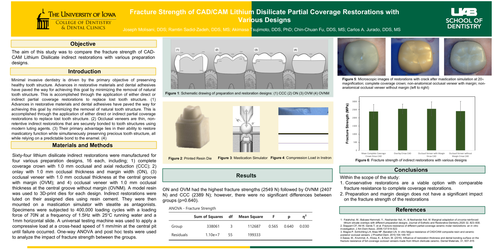
Sixty-four lithium disilicate indirect restorations were manufactured for four various preparation designs, 16 each, including; 1) complete coverage crown with 1.0 mm occlusal and axial reduction (CCC); 2) onlay with 1.0 mm occlusal thickness and margin width (ON), (3) occlusal veneer with 1.0 mm occlusal thickness at the central groove with margin (OVM); and 4) occlusal veneer with 1.0 mm occlusal thickness at the central groove without margin (OVNM). A model resin was used to 3D-print dies for each design. Indirect restorations were luted on their assigned dies using resin cement. They were then mounted on a mastication simulator with steatite as antagonists. Specimens were subjected to 400,000 loading cycles with a loading force of 70N at a frequency of 1.5Hz with 25°C running water and a 1mm horizontal slide. A universal testing machine was used to apply a compressive load at a cross‐head speed of 1 mm/min at the central pit until failure occurred. One-way ANOVA and post hoc tests were used to analyze the impact of fracture strength between the groups.
Results
ON and OVM had the highest fracture strengths (2549 N) followed by OVNM (2407 N) and CCC (2389 N); however, there were no significant differences between groups (p=0.640).
Conclusions
Within the scope of the study:
2. Stappert CF, Att W, Gerds T, et al. Fracture resistance of different partial-coverage ceramic molar restorations: an in vitro investigation. J Am Dent Assoc. 2006;137:514-522.
3. Magne P, Schlichting LH, Maia HP, Baratieri LN. In vitro fatigue resistance of CAD/CAM composite resin and ceramic posterior occlusal veneers. J Prosthet Dent. 2010;104:149-157.
4.Sasse, M., Krummel, A., Klosa, K., & Kern, M. (2015). Influence of restoration thickness and dental bonding surface on the fracture resistance of full‐coverage occlusal veneers made from lithium disilicate ceramic. Dental Materials, 31, 907–915