127 posters, 2 topics, 24 sessions, 326 authors, 85 institutions
ePostersLive by SciGen Technologies S.A. All rights reserved.
2023 ACP ANNUAL SESSION
October 25-28 | San Diego, CA

119
Comparison of Surface roughness and bacterial colonization of recently used dental ceramics.
Poster Presenter
Authors
Affiliations
Part of Topic
Original Research
Comparison of Surface roughness and bacterial colonization of recently used dental ceramics.
Amr Abouzeid 1, Van Ramos2, Daniel Chan3, Sumita Jain4
1. Resident, Graduate Prosthodontics, School of Dentistry, University of Washington School of Dentistry, Seattle, WA
2. Program Director, Graduate Prosthodontics, School of Dentistry, University of Washington School of Dentistry, Seattle, WA
3. Chair, Department of Restorative Dentistry, School of Dentistry, University of Washington School of Dentistry, Seattle, WA
4. Department of Periodontics School of Dentistry, University of Washington School of Dentistry, Seattle, WA
Objective:
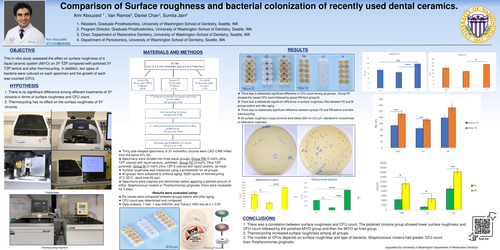
This in vitro study assessed the effect on surface roughness of a liquid ceramic system (MiYO) on 3Y TZP compared with polished 3Y TZP before and after thermocycling. In addition, two types of bacteria were cultured on each specimen and the growth of each was counted (CFU).
Hypothesis:
1. There is no significant difference among different treatments of 3Y zirconia in terms of surface roughness and CFU count.
2. Thermocycling has no effect on the surface roughness of 3Y zirconia.
Material & Methods:
★ Thirty disk-shaped specimens of 3Y monolithic zirconia were CAD-CAM milled from the same STL file.
★ Specimens were divided into three equal groups. Group PM (3 mol% yttria TZP, colored with liquid ceramic, polished). Group PZ (3 mol% Yttria TZP, polished). Group M (3 mol% yttria TZP & colored with liquid ceramic, as fired)
★ Surface roughness was measured using a profilometer for all groups.
★ All groups were subjected to artificial aging: 5000 cycles of thermocycling (5°C-55°C, dwell time 20 sec)
★ Specimens were cleaned and disinfected before applying a defined amount of either Streptococcus mutans or Porphyromonas gingivalis. Discs were incubated for 5 days.
-Results were evaluated using-
★ Ra values were compared between groups before and after aging.
★ CFU count was determined and compared.
★ Data analysis: T-test, 1-way ANOVA, and Tukey’s HSD test at α = 0.05.
Results:
★ There was a statistically significant difference in CFU count among all groups. Group PZ showed the lowest CFU count followed by group PM then group M.
★ There was a statistically significant difference in surface roughness (Ra) between PZ and M groups before and after aging.
★ There was no statistically significant difference between groups PZ and PM before and after thermocycling.
★ All surface roughness measurements were below 200 nm (0.2 µm- standard for smoothness of restorative materials)
Conclusion:
1. There was a correlation between surface roughness and CFU count. The polished zirconia group showed lower surface roughness and CFU count followed by the polished MiYO group then the MiYO as fired group.
2. Thermocycling increased surface roughness among all groups.
3. The number of CFUs depends on surface roughness and type of bacteria; Streptococcus mutans had greater CFU count than Porphyromonas gingivalis.