127 posters, 2 topics, 24 sessions, 326 authors, 85 institutions
ePostersLive by SciGen Technologies S.A. All rights reserved.
2023 ACP ANNUAL SESSION
October 25-28 | San Diego, CA

122
Physico-Chemical and Mechanical Behavior of Interim Restoration Materials
Poster Presenter
Authors
Affiliations
DUMMY, University of British columbia, University of British columbia
Part of Topic
Original Research
Physico-Chemical and Mechanical Behavior of Interim Restoration Materials
Elham Vakili, DDS, MScª, Ricardo M Carvalho, DDS, PhD, FADMᵇ
a: MSc Candidate, Prosthodontics Resident, University of British Columbia, b: Professor & Head, Dept. of Oral Biological and Medical Sciences, Professor of Biomaterials, University of British Columbia, Faculty of Dentistry, Vancouver, Canada
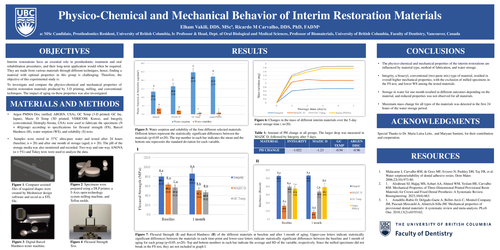
Objective: Interim restorations have an essential role in prosthodontic treatment and oral rehabilitation procedures, and their long-term application would often be required. They are made from various materials through different techniques, hence, finding a material with optimal properties in this group is challenging. Therefore, the objective of this experimental study is:
To investigate and compare the physico-chemical and mechanical properties of interim restoration materials produced by 3-D printing, milling, and conventional techniques. The impact of aging on these properties was also investigated.
Materials and Methods: Argen PMMA Disc (milled; ARGEN, USA), GC Temp (3-D printed; GC Inc. Japan), Mazic D Temp (3D printed; VERICOM. Korea), and Integrity (conventional; Dentsply-Sirona, USA) were used to fabricate the specimens (N = 40/group) according to specifications for flexural strength (FS), Barcol Hardness (H), water sorption (WS), and solubility (S) tests.
Samples were stored in 37°C ultra-pure water and tested after 24 hours (baseline; n = 20) and after one month of storage (aged; n = 20). The pH of the storage media was also monitored and recorded. Two-way and one-way ANOVA (α = 5%) and Tukey tests were used to analyze the data.
Conclusion:
The physico-chemical and mechanical properties of the interim restorations are influenced by material type, method of fabrication, and water storage.
Integrity, a bisacryl, conventional (two-paste mix) type of material, resulted in overall higher mechanical properties, with the exclusion of milled specimens in the FS test, and lower WS among the tested materials.
Storage in water for one month resulted in different outcomes depending on the material, and reduced properties was not observed for all materials.
Maximum mass change for all types of the materials was detected in the first 24 hours of the water storage period.