127 posters, 2 topics, 24 sessions, 326 authors, 85 institutions
ePostersLive by SciGen Technologies S.A. All rights reserved.
2023 ACP ANNUAL SESSION
October 25-28 | San Diego, CA

95
Stress Analysis FEA of Full Pontic cantilevered and Mid Pontic cantilevered Implant fixed Prosthesis
Poster Presenter
Part of Topic
Original Research
FEA Stress Analysis of Full and Mid-Pontic Cantilevered Implant Prostheses
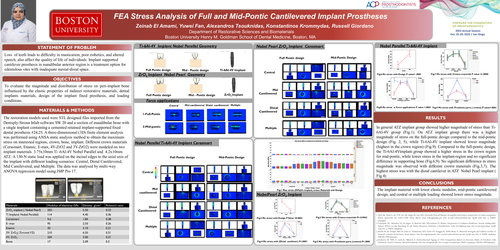
Objective To evaluate the magnitude and distribution of stress on peri-implant bone influenced by the elastic properties of indirect restorative materials, dental implant materials, design of the implant fixed prosthesis, and loading conditions
M & M
The restoration models used were STL-designed files imported from the Dentsply-Sirona Inlab software SW 20 and a section of mandibular bone with a single implant containing a cemented retained implant bridge#24,25. A three-dimensional (3D) finite element analysis was performed using ANSA static analysis method to obtain the maximum stress on interested regions, crown, bone, and implant. Different crown materials (Cerasmart, Enamic, E-max, 4Y-ZrO2 and 3Y-ZrO2) were modeled on two implant materials. 3.75x10mm TiNobelParallel and 4.2x10mm ATZ. A 150-N static load was applied on the incisal edges to the axial axis of the implant with different loading scenarios: Central, Distal Cantilevered, Mid Cantilevered, and Multiple. The data was analyzed by multi-way ANOVA regression model using JMP Pro 17..
Results
In general ATZ implant group showed a higher magnitude of stress than Ti group (Fig.1). On ATZ implant group there was a higher magnitude of stress on the full-pontic design compared to the mid-pontic design (Fig. 2, 5), while Ti implant showed a lower magnitude (highest in the crown region) (Fig.9). Compared to the full-pontic design, the Ti implant group showed a higher stress in the crown region for mid-pontic, while lower stress in the implant region and no significant difference in supporting bone (Fig.6,9). No significant difference in stress magnitude was observed with different crown materials (Fig.3,7). The highest stress was with the distal cantilever in ATZ NobelPearl implant ( Fig.
Conclusions
The implant material with lower elastic modulus, mid-pontic cantilevered design, and central or multiple loading showed lower stress magnitude