127 posters, 2 topics, 24 sessions, 326 authors, 85 institutions
ePostersLive by SciGen Technologies S.A. All rights reserved.
2023 ACP ANNUAL SESSION
October 25-28 | San Diego, CA
91
A Remarkable Journey: The Evolution of Full Arch Implant-Supported Prosthodontic Restorative Materials
Poster Presenter
Authors
Affiliations
Part of Topic
Original Research
Introduction:
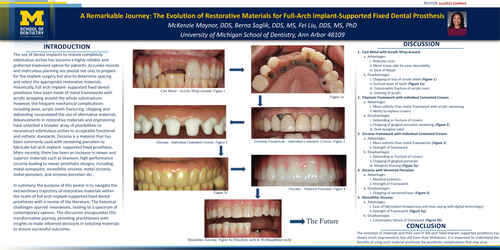
The use of dental implants to restore completely edentulous arches has become a highly reliable and preferred treatment option for patients. Accurate records and meticulous planning are pivotal not only to prepare for the implant surgery but also to determine spacing and select the appropriate restorative materials. Historically, full arch implant- supported fixed dental prosthesis have been made of metal frameworks with acrylic wrapping around the whole substructure. However, the frequent mechanical complications including wear, acrylic teeth fracturing, chipping and debonding necessitated the use of alternativematerials. Advancements in restorative materials and engineering have unlocked a broader array of possibilities to reconstruct edentulous arches to acceptable functional and esthetic standards. Zirconia is a material that has been commonly used with veneering porcelain to fabricate full arch implant- supported fixed prosthesis. More recently, there has been an increase in newer and superior materials such as titanium, high performance zirconia leading to newer prosthetic designs, including, metal-composite, monolithic zirconia, metal-zirconia, metal-porcelain, and zirconia-porcelain etc..
In summary, the purpose of this poster is to navigate the extraordinary trajectory of restorative materials within the realm of full arch implant-supported fixed dental prostheses with a review of the literature. The historical challenges spurred innovations, leading to a spectrum of contemporary options. The discussion encapsulates this transformative journey, providing practitioners with insights to make informed decisions in selecting materials to ensure successful outcomes.
Discussion
The evolution of materials and their uses in full-arch fixed implant supported prosthesis has shown much improvement, but still have their limitations. It is important to understand the benefits of using each material and know the prosthetic complications that may arise.