127 posters, 2 topics, 24 sessions, 326 authors, 85 institutions
ePostersLive by SciGen Technologies S.A. All rights reserved.
2023 ACP ANNUAL SESSION
October 25-28 | San Diego, CA

83
COMPARATIVE ANALYSIS OF PARTIALLY EDENTULOUS STONE MODEL SURVEYING: ANALOG vs DIGITAL (USING 3POINTX EXCALIBUR)
Poster Presenter
Authors
Affiliations
Part of Topic
Original Research
Analog vs. 3pointx Excalibur Digital Surveys of Partially Edentulous Stone Models: A Comparative Pilot Study
Antara Goswami BDS, Andriy Yuzvyak DDS, Mijin Choi DDS, MS, MBA, FACP
Jonathan and Maxine Ferencz Advanced Education Program in Prosthodontics New York University College of Dentistry
Introduction:-
Digital impression-making with intraoral scanners is becoming increasingly prevalent in dentistry. Studies have shown that digital intraoral impressions offer several advantages over traditional methods.1 As a result, there is a growing need to understand emerging software for removable partial denture design.
The traditional analog surveying technique remains foundational for evaluating key parameters like retentive undercuts and the path of insertion. These factors are crucial for the effective designing of removable partial dentures, making the analog method a trusted approach for many years.
Conversely, the 3pointx Excalibur software (3pointx.com, Fremont, OH) enhances the process by automating the analysis and providing superior visualization. This may lead to greater accuracy and minimize potential human errors.
Objective:-
This research aims to compare the accuracy of traditional analog method of surveying partially edentulous stone models with the advanced digital 3pointx Excalibur software.
Methods:-
Three different partially edentulous stone models were surveyed using an analog surveyor, surveying table and carbon marker. Different axes (X,Y,Z) were marked while on the surveying table such that the X and Z axes were parallel to the base of the surveyor and Y axis perpendicular to it. These axes served to reproduce the 3-dimensional orientation of the casts.
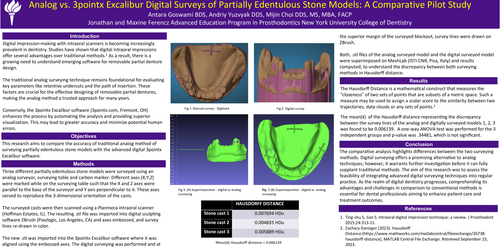
The surveyed casts were then scanned using a Planmeca intraoral scanner (Hoffman Estates, IL). The resulting .stl file was imported into digital sculpting software ZBrush (Pixologic, Los Angeles, CA) and axes embossed, and survey lines re-drawn in color.
The new .stl was imported into the 3pointx Excalibur software where it was aligned using the embossed axes. The digital surveying was performed and at the superior margin of the surveyed blockout, survey lines were drawn on ZBrush.
Both, .stl files of the analog surveyed model and the digital surveyed model were superimposed on MeshLab (ISTI-CNR, Pisa, Italy) and results computed, to understand the discrepancy between both surveying methods in Hausdorff distance.
Results:-
The Hausdorff Distance is a mathematical construct that measures the "closeness" of two sets of points that are subsets of a metric space. Such a measure may be used to assign a scalar score to the similarity between two trajectories, data clouds or any sets of points.2
The mean(x̄) of the Hausdorff distance representing the discrepancy between the survey lines of the analog and digitally surveyed models 1, 2, 3 was found to be 0.006139. A one-way ANOVA test was performed for the 3 independent groups and p-value was .34481, which is not significant.
Conclusion:-
The comparative analysis highlights differences between the two surveying methods. Digital surveying offers a promising alternative to analog techniques; however, it warrants further investigation before it can fully supplant traditional methods. The aim of this research was to assess the feasibility of integrating advanced digital surveying techniques into regular practice. As the realm of digital dentistry progresses, comprehending its advantages and challenges in comparison to conventional methods is essential for dental professionals aiming to enhance patient care and treatment outcomes.
References:-
2.Zachary Danziger (2023). Hausdorff Distance (https://www.mathworks.com/matlabcentral/fileexchange/26738-hausdorff-distance), MATLAB Central File Exchange. Retrieved September 23, 2023