127 posters, 2 topics, 24 sessions, 326 authors, 85 institutions
ePostersLive by SciGen Technologies S.A. All rights reserved.
2023 ACP ANNUAL SESSION
October 25-28 | San Diego, CA
80
The Effect of Multiple Translucency Heat-Treatment Cycles on the Mechanical and Optical Properties of a New Lithium Disilicate CAD/CAM Material.
Poster Presenter
Authors
Ahmad Reza Edalati Sharbaf, Heidar Shahin, Evangelia Gkoulitou, Amir Nejat, Xiaoming Xu, Karen Bruggers
Affiliations
Part of Topic
Original Research
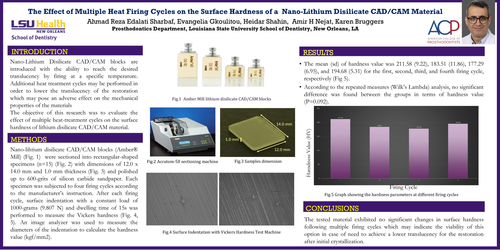
The Effect of Multiple Heat Firing Cycles on the Surface Hardness of a Nano-Lithium Disilicate CAD/CAM Material
Introduction
Nano-Lithium Disilicate CAD/CAM blocks are introduced with the ability to reach the desired translucency by firing at a specific temperature. Additional heat treatment cycles may be performed in order to lower the translucency of the restoration which may pose an adverse effect on the mechanical properties of the materials. The objective of this research was to evaluate the effect of multiple heat-treatment cycles on the surface hardness of lithium disilicate CAD/CAM material.
Methods
Nano-lihtium disilicate CAD/CAM blocks (Amber® Mill) (Fig. 1) were sectioned into rectangular-shaped specimens (n=15) (Fig. 2) with dimensions of 12.0 x 14.0 mm and 1.0 mm thickness (Fig. 3) and polished up to 600-grits of silicon carbide sandpaper. Each specimen was subjected to four firing cycles according to the manufacturer’s instruction. After each firing cycle, surface indentation with a constant load of 1000-grams (9.807 N) and dwelling time of 15s was performed to measure the Vickers hardness (Fig. 4, 5). An image analyzer was used to measure the diameters of the indentation to calculate the hardness value (kgf/mm2).
Resuts
The tested material exhibited no significant changes in surface hardness following multiple firing cycles which may indicate the viability of this option in case of need to achieve a lower translucency for the restoration after initial crystallization.