127 posters, 2 topics, 24 sessions, 326 authors, 85 institutions
ePostersLive by SciGen Technologies S.A. All rights reserved.
2023 ACP ANNUAL SESSION
October 25-28 | San Diego, CA

60
Implant Crown Screw Loosening: Best Evidence Statements
Poster Presenter
Authors
Affiliations
DUMMY, New York University College of Dentistry PG Prosthodontics
Part of Topic
Original Research
Implant Restoration Screw Loosening: Incidence and Critical Factors
Alexander Komar DMD MA, Mijin Choi DDS MS MBA FACP
INTRODUCTION:
The interface between the implant, abutment, and prosthetic is a complex mechanical system exposed to significant forces. The design of this interface, central to resolving a range of clinical challenges, remains a topic of intense discussion. One universally acknowledged technical complication associated with implant restorations is screw loosening.1,2 As the variety of implant-abutment-prosthetic interface designs expands annually, understanding the core factors that contribute to the loss of screw preload is paramount.
OBJECTIVES:
The purpose of this literature review is to report on the clinical incidence of implant restoration screw loosening from 2018 to 2023 and identify critical design and clinical factors associated with screw loosening.
METHODS:
A literature search was conducted through PubMed of articles published from 2018 to 2023 using search terms dental implant crown and screw loosening. Results were limited to clinical studies, clinical trials, and randomized controlled trials yielding 8 results. Studies that did not report number of screw loosening events or provide descriptions of the implant, abutment, and types of restorations/prostheses were excluded from evaluation. A total of 6 articles met these criteria and were used to generate results regarding incidence of implant restoration screw loosening.
A secondary literature search was conducted to identify etiologic factors associated with screw loosening. Using the same search terms, but limiting results to systematic reviews and meta-analyses, yielded 9 results. Studies specifically identifying factors associated with screw loosening were included for evaluation. While all reviews offer valuable reports on incidence of screw loosening, 3 specifically tracked factors associated with screw loosening, and only 2 were able to identify statistically significant contributors.
RESULTS:
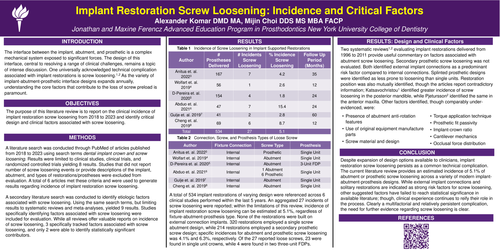
A total of 534 implant restorations of varying design were referenced across 6 clinical studies performed within the last 5 years. An aggregated 27 incidents of screw loosening were reported; within the limitations of this review, incidence of implant restoration screw loosening can be estimated at 5.1%, regardless of fixture-abutment-prosthesis type. None of the restorations were built on external connection implants. 320 restorations employed a single screw abutment design, while 214 restorations employed a secondary prosthetic screw design; specific incidences for abutment and prosthetic screw loosening was 4.1% and 6.3%, respectively. Of the 27 reported loose screws, 23 were found in single unit crowns, while 4 were found in two three-unit FDPs.
Two systematic reviews1,2 evaluating implant restorations delivered from 1996 to 2011 provide useful commentary on factors associated with abutment screw loosening. Secondary prosthetic screw loosening was not evaluated. Both identified external implant connections as a predominant risk factor compared to internal connections. Splinted prosthetic designs were identified as less prone to loosening than single units. Restoration position was also mutually identified, though the articles report contradictory information; Katsavochristou1 identified greater incidence of screw loosening in the posterior mandible, while Pjetursson2 identified the same in the anterior maxilla. Other factors identified, though comparably under-evidenced, were:
Despite expansion of design options available to clinicians, implant restoration screw loosening persists as a common technical complication. The current literature review provides an estimated incidence of 5.1% of abutment or prosthetic screw loosening across a variety of modern implant-abutment-prosthesis designs. While external implant connections and solitary restorations are indicated as strong risk factors for screw loosening, other suggested factors have failed to reach statistical significance in available literature; though, clinical experience continues to reify their role in the process. Clearly a multifactorial and relatively persistent complication, the need for further evidence regarding screw loosening is clear.