127 posters, 2 topics, 24 sessions, 326 authors, 85 institutions
ePostersLive by SciGen Technologies S.A. All rights reserved.
2023 ACP ANNUAL SESSION
October 25-28 | San Diego, CA

50
Dimensional Accuracy of Milled Versus Printed 4-Unit Monolithic Zirconia Fixed Partial Dentures
Poster Presenter
Part of Topic
Original Research
Dimensional Accuracy of Milled Versus Printed 4-Unit Monolithic Zirconia Fixed Partial Dentures
Samantha Lakhia DDS, Thomas Giugliano DDS, Lukasz Witek MS, PhD, Malvin Janal PhD, Mijin Choi DDS, MS, MBA, FACP
Jonathan and Maxine Ferencz Advanced Education Program in Prosthodontics New York University College of Dentistry
Introduction:
In recent years there has been an explosion of digital integration into dental practices.1,2 One of the most widely used digital advancements in the field of dentistry are intraoral optical scanners (IOS).1,2 Advancements in IOS have resulted in improved data storage capabilities, and in turn Intraoral Optical Impressions (IOI) with a higher level of trueness and precision.1 Trueness dictates how close a measurement is to the actual dimension of the object being scanned, and precision refers to consistency of scan measurements.1 Recent studies suggested that a completely digital workflow resulted in definitive restorations with significantly better internal fit and marginal fit than restorations fabricated with conventional impression techniques.3,4 With improvements in the precision of capturing and recording preparation margins, there is potential to fabricate dental restorations with increased accuracy.1 Milled restorations are constrained by bur size and angulation. However, recent advancements in printing definitive zirconia restorations may provide enhanced precision in restoration fabrication.5
Objectives:
The aim of this study is to compare the effect of Computer-Aided Manufacturing (CAM) technique, milling and printing, on the accuracy of replicating a digitally designed 4-unit Fixed Partial Denture (FPD) prosthesis. The null hypothesis is that there is no statistically significant difference in the dimensional accuracy of milled versus printed 4-unit monolithic zirconia FPD prostheses.
Methods:
A 4-unit fixed partial denture with two abutment teeth (first premolar and first molar) and two pontics was digitally designed, using a scanned stl of a metal master model, on ZBrush software (Pixologic, Los Angeles, CA) using 52,244 data points. The resulting .stl file servedas the control. A total of 30 test samples were fabricated utilizing two different computer-aided manufacturing techniques: Milling using five-axis milling machine (model TR5, vhf Inc., Hauppauge, NY) (Group 1, n=15) and printing using Aon (Seoul, South Korea) Zipro-D three-dimensional printer (Group 2, n=15). The samples from each group were scanned using a D2000 3Shape desktop scanner (Copenhagen, Denmark) and the resulting .stl files were superimposed onto the control .stldesign using CloudComparesoftware (Dublin, Ireland). Discrepancies in overall dimensionswere quantified for both groups and averaged. Percent variation was calculated for each group using a two-way ANOVA test.
Results:
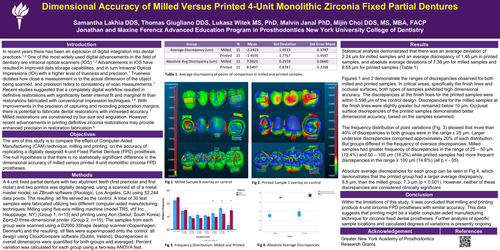
Stistical analysis demonstrated that there was an average deviation of 2.24 µm for milled samples and an average discrepancy of 1.46 µm in printed samples, and absolute average deviations of 7.38 µm for milled samples and 8.55 µm for printed samples (Table 1).
Figures 1 and 2 demonstrate the ranges of discrepancies observed for both milled and printed samples. In critical areas, specifically the finish lines and occlusal surfaces, both types of samples exhibited high dimensional accuracy. The discrepancies at the finish lines for the printed samples were within 0.598 µm of the control design. Discrepancies for the milled samples at the finish lines were slightly greater but remained below 10 µm. Occlusal surface discrepancies of the printed samples demonstrated better dimensional accuracy, based on the samples examined.
The frequency distribution of point variations (Fig. 3) showed that more than 40% of discrepancies in both groups were in the range ± 25 µm. Larger undersize discrepancies comprised approximately 20% of each distribution. But groups differed in the frequency of oversize discrepancies. Milled samples had greater frequency of discrepancies in the range of 25 – 50 µm (12.4%) and 50 – 100 µm (16.2%) while printed samples had more frequent discrepancies in the range ≥ 100 µm (14.6%) (all p < -.05).
Absolute average discrepancies for each group can be seen in Fig 4, which demonstrates that the printed group had a larger average discrepancy, 8.5 µm, than the milled group, 7.3 µm (p < 0.001). However, neither of these discrepancies are considered clinically significant.
Conclusion:
Within the limitations of this study, it was concluded that milling and printing produce 4-unit zirconia FPD prostheses with similar accuracy. This data suggests that printing might be a viable computer-aided manufacturing technique for zirconia fixed dental prostheses. Further analysis of specific sample locations and calculated degrees of variations is presently ongoing.
Acknowledgement:
Greater New York Academy of Prosthodontics Research Grants
References:
(QR Code Link to references provided)