127 posters, 2 topics, 24 sessions, 326 authors, 85 institutions
ePostersLive by SciGen Technologies S.A. All rights reserved.
2023 ACP ANNUAL SESSION
October 25-28 | San Diego, CA

49
The accuracy of fit and occlusion of digitally and conventionally constructed Michigan occlusal appliances
Poster Presenter
Authors
Mohammed Alsammarraie, Alan Hannam, David Tobias, Jonathan Ng, Mohamed Gebril, Chris Wyatt
Affiliations
Part of Topic
Original Research
Objectives
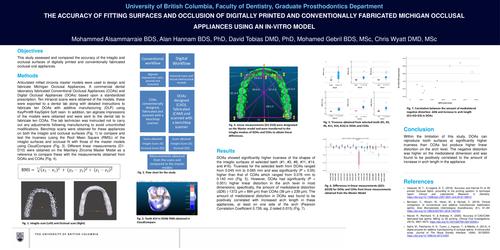
This study assessed and compared the accuracy of the intaglio and occlusal surfaces of digitally printed and conventionally fabricated occlusal oral appliances.
Methods
Articulated milled zirconia master models were used to design and fabricate Michigan Occlusal Appliances. A commercial dental laboratory fabricated Conventional Occlusal Appliances (COAs) and Digital Occlusal Appliances (DOAs) based upon a standardized prescription. Ten intraoral scans were obtained of the models, these were exported to a dental lab along with detailed instructions to fabricate ten DOAs with additive manufacturing (DLP) using KeyPrint® KeySplint Soft resin. In addition, ten alginate impressions of the models were obtained and were sent to the dental lab to fabricate ten COAs. The lab technician was instructed not to carry out any adjustments following manufacturing to avoid uncontrolled modifications. Benchtop scans were obtained for these appliances on both the intaglio and occlusal surfaces (Fig. 1) to compare and test the trueness (using the Root Mean Square (RMS)) of the intaglio surfaces and occlusal fit with those of the master models using CloudCompare (Fig. 3). Different linear measurements (D1-D10) were obtained on the Maxillary Zirconia Master Model as a reference to compare these with the measurements obtained from DOAs and COAs (Fig. 4).
Results
DOAs showed significantly higher trueness of the shapes of the intaglio surfaces of selected teeth (#1, #3, #6, #11, #14, and #16). Trueness for the selected teeth from DOAs ranged from 0.045 mm to 0.065 mm and was significantly (P < 0.05) higher than that of COAs which ranged from 0.076 mm to 0.140 mm (Fig. 5). However, DOAs had significantly (P < 0.001) higher linear distortion in the arch level in most dimensions; specifically, the amount of mediolateral distortion (ΔD6) (-1372 µm ± 884 µm) than COAs (39 µm ± 239 µm). The amount of mediolateral distortion in DOAs was found to be positively correlated with increased arch length in these appliances, at least on one side of the arch (Pearson Correlation Coefficient 0.739, sig. 2-tailed 0.015) (Fig. 7).
Conclusion
Within the limitation of this study, DOAs can reproduce tooth surfaces at significantly higher trueness than COAs but produce higher linear distortion on the arch level. The negative distortion was higher on the mediolateral dimension and was found to be positively correlated to the amount of increase in arch length in the appliance.