127 posters, 2 topics, 24 sessions, 326 authors, 85 institutions
ePostersLive by SciGen Technologies S.A. All rights reserved.
2023 ACP ANNUAL SESSION
October 25-28 | San Diego, CA
48
Evaluating Patient Perceptions on the Practice Readiness of Prosthodontics Residents with Entrustable Professional Activities
Poster Presenter
Authors
Affiliations
Part of Topic
Original Research
Patient Perceptions on Transfer of Care Using the Entrustable Professional Activities EPA Model
Klara Deskovic DMD, Gabriela Lagreca DMD, DDS, MBA, FACP
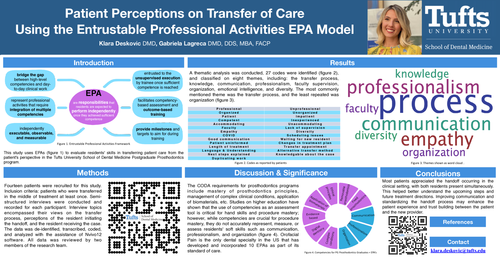
This study uses EPAs (figure 1) to evaluate residents' skills in transferring patient care from the patient's perspective in the Tufts University School of Dental Medicine Postgraduate Prosthodontics program.
Fourteen patients were recruited for this study. Inclusion criteria: patients who were transferred in the middle of treatment at least once. Semi-structured interviews were conducted and recorded for each participant. Interview topics encompassed their views on the transfer process, perceptions of the resident initiating the handoff, and the resident receiving the case. The data was de-identified, transcribed, coded, and analyzed with the assistance of Nvivo12 software. All data was reviewed by two members of the research team.
A thematic analysis was conducted, 27 codes were identified (figure 2), and classified on eight themes, including: the transfer process, knowledge, communication, professionalism, faculty supervision, organization, emotional intelligence, and diversity. The most commonly mentioned theme was the transfer process, and the least repeated was organization (figure 3).
The CODA requirements for prosthodontics programs include mastery of prosthodontics principles, management of complex clinical conditions, application of biomaterials, etc. Studies on higher education have shown that the use of competencies as an assessment tool is critical for hand skills and procedure mastery; however, while competencies are crucial for procedure mastery, they do not accurately represent, measure, or assess residents' soft skills such as communication, professionalism, and organization (figure 4). Orofacial Pain is the only dental specialty in the US that has developed and incorporated 10 EPAs as part of its standard of care.
Most patients appreciated the handoff occurring in the clinical setting, with both residents present simultaneously. This helped better understand the upcoming steps and future treatment directions. Improving communication and standardizing the handoff process may enhance the patient experience and trust building between the patient and the new provider.