127 posters, 2 topics, 24 sessions, 326 authors, 85 institutions
ePostersLive by SciGen Technologies S.A. All rights reserved.
2023 ACP ANNUAL SESSION
October 25-28 | San Diego, CA

26
Effect of Printing Parameters and Storage Conditions on The Tensile Properties of Two Different Types of 3D-Printed Splint Materials
Poster Presenter
Part of Topic
Original Research
Effect of Printing Parameters and Storage Conditions on the Tensile Properties of Two Different Types of 3D-Printed Splint Materials
Setthawut Choochaisaengrat, Yuwei Fan, Russell Giordano II, Department of Restorative Sciences & Biomaterials, Boston University Henry M. Goldman School of Dental Medicine, Boston, MA
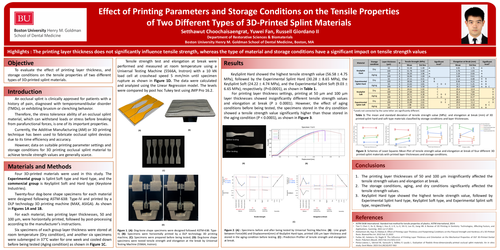
Highlights: The printing layer thickness does not significantly influence tensile strength, whereas the type of material and storage conditions have a significant impact on tensile strength values
Objective: To evaluate the effect of printing layer thickness and storage conditions on the tensile properties of two different types of 3D-printed splint materials.
Introduction: An occlusal splint is clinically approved for patients with a history of pain, diagnosed with temporomandibular disorder (TMDs), or exhibiting bruxism or clenching behavior. Therefore, the stress tolerance ability of an occlusal splint material, which can withstand loads or stress before breaking from parafunctional forces, is one of its important properties. Currently, the Additive Manufacturing (AM) or 3D printing technique has been used to fabricate occlusal splint devices due to its time efficiency and accuracy. However, data on suitable printing parameter settings and storage conditions for 3D printing occlusal splint material to achieve tensile strength values are generally scarce.
Materials and Methods: Four 3D-printed materials were used in this study. The experimental group is Splint Soft type and Hard type, and the commercial group is KeySplint Soft and Hard type (Keystone Industries). Twenty-four dog-bone shape specimens for each material were designed following ASTM-638: Type-IV and printed by a DLP technology 3D printing machine (MAX, ASIGA). As shown in Figures 1A and 1B. For each material, two printing layer thicknesses, 50 and 100 μm, were horizontally printed, followed by post-processing according to the manufacturer's instructions. Six specimens of each group layer thickness were stored at room temperature (Dry condition), and another six specimens were submerged in 37°C water for one week and cooled down before being tested (Aging condition) as shown in Figure 1C. Tensile strength test and elongation at break were performed and measured at room temperature using a Universal Testing Machine (5566A, Instron) with a 10 kN load cell at crosshead speed 5 mm/min until specimen rupture, as shown in Figure 1D. The data were calculated and analyzed using the Linear Regression model. The levels were compared by post hoc Tukey test using JMP Pro 16.2.
Results: KeySplint Hard showed the highest tensile strength value (56.58 ± 4.75 MPa), followed by the Experimental Splint Hard (30.28 ± 8.65 MPa), the KeySplint Soft (24.22 ± 4.74 MPa), and the Experimental Splint Soft (9.03 ± 6.65 MPa), respectively. (P<0.0001), as shown in Table 1. For printing layer thickness settings, printing at 50 μm and 100 μm layer thicknesses showed insignificantly different tensile strength values and elongation at break (P ≥ 0.0001). However, for the effect of aging conditions before being tested, the specimens stored in the dry condition showed a tensile strength value significantly higher than those stored in the aging condition (P < 0.0001), as shown in Figure 4.
Conclusions