127 posters, 2 topics, 24 sessions, 326 authors, 85 institutions
ePostersLive by SciGen Technologies S.A. All rights reserved.
2023 ACP ANNUAL SESSION
October 25-28 | San Diego, CA

191
Influence of Single Implant Submersion to Smile Attractiveness due to Continuous Craniofacial Growth
Poster Presenter
Part of Topic
Original Research
Influence of Single Implant Submersion Due to Continuous Craniofacial Growth to Smile Attractiveness
Purpose: To evaluate the influence of a single infraoccluded dental implant, to smile attractiveness.
Introduction: Restoring single missing teeth in the anterior zone with dental implants, has been established as a viable option in contemporary practice. An optimal long-term clinical result has to be related not only to peri-implant health, but also to the esthetic outcomes of the implant retained crown, as soft tissue topography around the implant supported restoration and the position of its crown in relation to the adjacent teeth and the surrounding tissues. Some negative observations, that have been reported for long-term esthetic outcomes, are derived by the inability of dental implants to adapt to positional changes of the natural dentition. Several researchers have investigated the prevalence of infraocclusion of a single dental implant in anterior zone, however the influence of the deficiencies derived from a single infraoccluded implant to the attractiveness of the smile has not been studied yet.
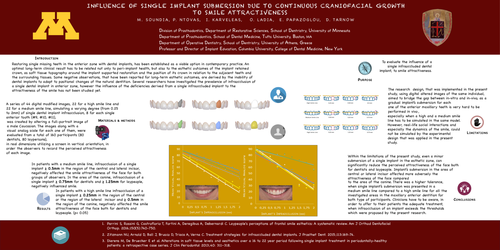
Materials and Methods: A series of 44 digital modified images, 22 for a high smile line and 22 for a medium smile line, simulating a varying degree (from 0.25 to 2mm) of single dental implant infraocclusion, 8 for each single anterior tooth (#9, #10, #11), was created by altering a full-portrait image of a male Caucasian. The images along with a visual analog scale for each one of them, were evaluated from a total of 160 participants (80 dentists, 80 laypersons), in real dimensions utilizing a screen in vertical orientation, in order the observers to record the perceived attractiveness of each image.
Results: In patients with a medium smile line, infraocclusion of a single implant ≥ 0.5mm in the region of the central and lateral incisor, negatively affected the smile attractiveness of the face for both groups of observers. In the area of the canine, infraocclusion of a single implant ≥ 0.75mm for dentists and ≥ 1.25mm for laypeople, negatively influenced smile. In patients with a high smile line infraocclusion of a single implant ≥ 0.25mm in the region of the central or the region of the lateral incisor and ≥ 0.5mm in the region of the canine, negatively affected the smile attractiveness of the face both for dentists and laypeople. (p< 0.05)
Limitations: The research design, that was implemented in the present study, using digital altered images of the same individual, aimed to bridge the gap between in-vitro and in-vivo, as a gradual implant’s submersion for each one of the anterior maxillary teeth is very hard to be performed in vivo, especially when a high and a medium smile line has to be simulated in the same model. However, real-life social interactions and especially the dynamics of the smile, could not be simulated by the experimental design that was applied in the present study.
Conclusions: Within the limitations of the present study, even a minor submersion of a single implant in the esthetic zone, can significantly reduce the perceived attractiveness of the face both for dentists and laypeople. Implant’s submersion in the area of central or lateral incisor affected more adversely the attractiveness of the face compared to the area of the canine. There was a higher tolerance, when single implant’s submersion was presented in a medium smile line compared to a high smile line for all the investigated areas in the maxillary anterior dentition for both type of participants. Clinicians have to be aware, in order to offer to their patients the adequate treatment, when infraocclusion of an implant exceeds the thresholds which were proposed by the present research.