127 posters, 2 topics, 24 sessions, 326 authors, 85 institutions
ePostersLive by SciGen Technologies S.A. All rights reserved.
2023 ACP ANNUAL SESSION
October 25-28 | San Diego, CA

188
Accelerated Aging Protocol Based on Thermomechanical and Biochemical Challenges for Dental Bonding Agent Development
Poster Presenter
Authors
Affiliations
Part of Topic
Original Research
Accelerated Aging of Dentin-Resin Interface Via Thermomechanical and Biochemical Challenges
Jesse Barker, D.M.D., Yoav Finer, D.M.D., Ph.D., F.R.C.D.(C)
Faculty of Dentistry, University of Toronto, Toronto, Ont. Canada M5G 1G6
Abstract
Current in vitro protocols used to artificially age the hybrid layer interface between dentin and resin composite often require lengthy incubation periods. The effects of exposing hybrid layer specimens to biochemical and thermocycling challenges together in vitro may shorten the time required to induce hybrid layer aging.
A recently developed biochemical and thermocycling aging protocol (BC-TC) was found to accelerate the chemical aging of the adhesive resins, significantly increasing the rate of 2,2-Bis[4(2,3-hydroxypropoxy)phenyl] propane (BisHPPP) and drug release in comparison to samples aged by biochemical challenge (BC) alone. The aim of this study is to test the BC-TC protocol to study the chemical and mechanical degradation of hybrid layer specimens incorporating enhanced total-etch adhesive resin formulations.
Octenidine dihydrochloride (OCT), a highly biocompatible cationic surfactant antiseptic molecule with no known bacterial resistance, exhibits broad efficacy against gram-positive and gram-negative bacteria. OCT has been suggested as a candidate to be incorporated into resin adhesives as an antiseptic within the hybrid layer. This ongoing study investigates whether in-house total-etch resin adhesive containing drug-eluting molecules loaded with OCT imparts a protective effect when exposed to BC-TC protocol.
Dentin-composite specimens are prepared, exposed to BC-TC artificial aging protocol using simulated human salivary esterase (SHSE) with thermocycling, and tested for fracture toughness (K1c) and fracture mode (FM).
Objectives
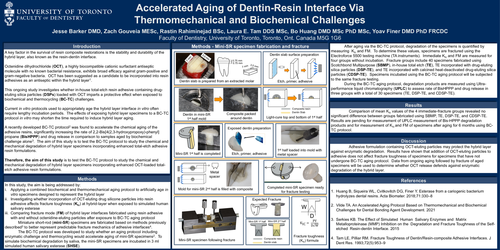
The BC-TC protocol was developed to study whether an aging protocol including enzymatic challenge and thermocycling would accelerate aging of mini-SR specimens. To simulate biochemical degradation by saliva, the mini-SR specimens are incubated in 3 ml simulated human salivary esterase (SHSE). To produce SHSE media, a solution consisting of cholesterol esterase (CE) and pseudocholinesterase (PCE) is used.
After aging via the BC-TC protocol, degradation of the specimens is quantified by measuring interfacial fracture toughness (K1c) and failure mode. To determine these values, specimens are individually mounted into a customized jig and fractured using the Electroforce 5500 testing machine (TA instruments, New Castle, Delaware). Immediate fracture toughness and fracture mode aremeasured for four groups without incubation. The 4 immediate fracture groups include specimens fabricated using Scotchbond Multipurpose (SBMP), in-house total etch (TE), TE incorporated with drug-eluting silica particles (DSP-TE), and TE incorporated with calcined heat-deactivated drug-eluting silica particles (CDSP-TE) (total 40 specimens). Specimens incubated using the BC-TC aging protocol will be subjected to the same fracture testing.
During the BC-TC aging protocol, degradation products will be measured using Ultra-performance liquid chromatography (UPLC) to assess rate of 2,2-Bis[4(2,3-hydroxypropoxy)phenyl] propane (BisHPPP) and drug release in three groups of specimens. The three groups exposed to the BC-TC aging protocol are TE, DSP-TE, and CDSP-TE (total 30 specimens)
Results
Fracture toughness of immediate fracture groups reveals no significant difference between groups fabricated using SBMP, TE, DSP-TE, and CDSP-TE. Results are pending for measurement of UPLC measurement of Bis-HPPP degradation products and for measurement of fracture toughness and fracture mode of specimens after 6-month aging using BC-TC protocol.
Discussion
Adhesive formulation containing OCT-eluting particles may protect the hybrid layer against enzymatic degradation. Results have shown that addition of OCT-eluting particles to adhesive does not affect fracture toughness of specimens for specimens that have not undergone BC-TC aging protocol. Data from ongoingaging followed by fracture of aged specimens will be used to determine whether OCT release defends against enzymatic degradation of the hybrid layer
References
Vilde TA. An Accelerated Aging Protocol Based on Thermomechanical and Biochemical Challenges for Dental Bonding Agent Development. 2021
Tam LE, Pilliar RM. Fracture Toughness of Dentin/Resin-composite Adhesive Interfaces. J Dent Res. 1993;72(5):953–9
Serkies KB. The Effect of Simulated Human Salivary Enzymes and Matrix Metalloproteinase (MMP) Inhibition on the Degradation and Fracture Toughness of the Self-etched Resin-dentin Interface. 2015
Huang B, Siqueira WL, Cvitkovitch DG, Finer Y. Esterase from a cariogenic bacterium hydrolyzes dental resins. Acta Biomater. 2018;71:330–8