127 posters, 2 topics, 24 sessions, 326 authors, 85 institutions
ePostersLive by SciGen Technologies S.A. All rights reserved.
2023 ACP ANNUAL SESSION
October 25-28 | San Diego, CA

165
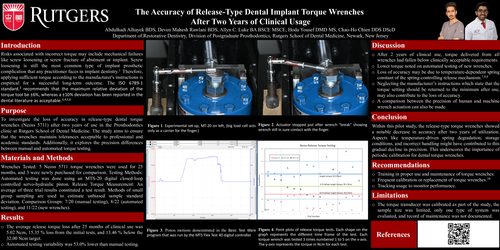
The Accuracy of Release-Type Dental Implant Torque Wrenches After Two Years of Clinical Usage
Poster Presenter
Authors
Abdulhadi Alhayek, Edward Chaoho Chien, Allyn Luke, Hoda Yousef, Deven Mahesh Rawlani
Affiliations
Part of Topic
Original Research
Introduction:
Risks associated with incorrect torque may include mechanical failures like screw loosening or screw fracture of abutment or implant. Screw loosening is still the most common type of implant prosthetic complication that any practitioner faces in implant dentistry.1 Therefore, applying sufficient torque according to the manufacturer's instructions is empirical for a successful long-term outcome. The ISO 6789-1 standard.2 recommends that the maximum relative deviation of the torque tool be ±6%, whereas a ±10% deviation has been reported in the dental literature as acceptable.3,4,5,6
Purpose:
To investigate the loss of accuracy in release-type dental torque wrenches (Neoss 5711) after two years of use in the Prosthodontics clinic at Rutgers School of Dental Medicine. The study aims to ensure that the wrenches maintain tolerances acceptable to professional and academic standards. Additionally, it explores the precision differences between manual and automated torque testing.
Materials and Methods:
Wrenches Tested: 5 Neoss 5711 torque wrenches were used for 25 months, and 3 were newly purchased for comparison. Testing Methods: Automated testing was done using an MTS-20 digital closed-loop controlled servo-hydraulic piston. Release Torque Measurement: An average of three trial results constituted a test result. Methods of small group sampling are used to estimate unbiased sample standard deviation. Comparison Groups: 7/20 (manual testing), 8/22 (automated testing), and 11/22 (new wrenches).
Results:
Discussion:
Conclusion
Within this pilot study, the release-type torque wrenches showed a notable decrease in accuracy after two years of utilization. Aspects like temperature-driven spring degradation, storage conditions, and incorrect handling might have contributed to this gradual decline in precision. This underscores the importance of periodic calibration for dental torque wrenches.
Recommendations: