127 posters, 2 topics, 24 sessions, 326 authors, 85 institutions
ePostersLive by SciGen Technologies S.A. All rights reserved.
2023 ACP ANNUAL SESSION
October 25-28 | San Diego, CA

16
Fracture Load Value of CAD-CAM Provisional Crowns - An in vitro Study
Poster Presenter
Part of Topic
Original Research
Fracture Load Value of CAD-CAM Provisional Crowns - An in vitro Study
Syed Zaeem Raza BDS, DDS; Amirali Zandinejad, DDS, MSc; Abdul Basir Barmak, MD, MSc, EdD; Rui Li, DDS, PhD; Ramtin Sadid-Zadeh DDS, MS
Objective
The purpose of this study was to evaluate fracture load value of 5 types of provisional crowns with and without thermocycling.
Introduction
Interim restorations become critical where several teeth are involved, and they may be used for relatively long periods, ensuring the maintenance of the health of the remaining tissues, monitoring their stability, and making the necessary adjustments possible. Subtractive and additive techniques have gained popularity due to improved physical and mechanical properties of interim restorations fabricated by computer aided manufacturing (CAM). In subtractive technique milling machines will be used to mill external and internal restorations. Additive techniques use a layer by layer manufacturing process to create a 3D object, allowing the manufacturing of complicated geometries while using less time and material than milling. The fracture strength of interim prosthesis is essential for long-term provisionalization. Many studies have evaluated the fracture strength of 3D-printed interim resin restorations and the effect of different variants on the fracture strength of printed prosthesis; the data on DLS 3D printing technology, however, are scarce.
Materials and Methods
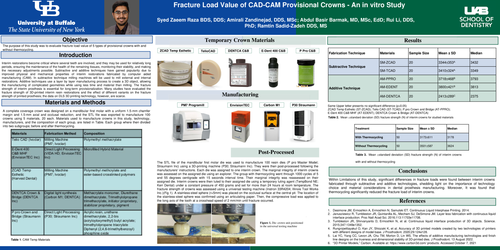
A complete coverage crown was designed on a mandibular first molar with a uniform 1.5-mm chamfer margin and 1.5-mm axial and occlusal reduction, and the STL file was exported to manufacture 100 crowns using 5 materials, 20 each. Materials used to manufacture crowns in this study, technology, manufacturers, and the composition of each group, are listed in Table. Each group where then divided into two subgroups; before and after thermocycling.
Temporary Crown Materials
Manufacturing
The STL file of the mandibular first molar die was used to manufacture 100 resin dies (P pro Master Model; Straumann Inc) using a 3D-printing machine (P30; Straumann Inc). They were then post-processed following the manufacturers' instructions. Each die was assigned to one interim crown. The marginal integrity of interim crowns was assessed on the assigned die using an explorer. The group with thermocycling went through 1000 cycles of 5 and 55 degrees centigrade with 15 seconds interval time. Their marginal integrity was reassessed on their assigned die. Interim crowns were then luted to their assigned die using a temporary luting agent (TempBond NE; Kerr Dental) under a constant pressure of 450 grams and set for more than 24 hours at room temperature. The fracture strength of crowns was assessed using a universal testing machine (Instron 33R4204; Illinois Tool Works Inc.)(Fig 1). A stainless-steel sphere (r=5mm) was placed on the occlusal surface at the central pit. The location of the stainless-steel sphere was confirmed using an articulating paper. Then, the compressive load was applied to the long axis of the tooth at a crosshead speed of 2 mm/min until fracture occurred.
Conclusions