127 posters, 2 topics, 24 sessions, 326 authors, 85 institutions
ePostersLive by SciGen Technologies S.A. All rights reserved.
2023 ACP ANNUAL SESSION
October 25-28 | San Diego, CA

155
The effects of anodization and instrumentation on titanium abutment surface characteristics and biofilm formation
Poster Presenter
Authors
Weiqing Liu, Richard Gregory, Yusuke Hamada, Chao-Chieh Yang, Wei-Shao Lin
Affiliations
Part of Topic
Original Research
Effects of Anodization and Instrumentation on Titanium Abutment Surface Characteristics and Biofilm Formation
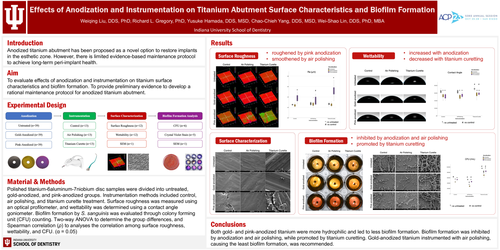
Introduction: Anodized titanium abutment has been proposed as a novel option to restore implants in the esthetic zone. However, there is limited evidence-based maintenance protocol to achieve long-term peri-implant health.
Aim: To evaluate effects of anodization and instrumentation on titanium surface characteristics and biofilm formation. To provide preliminary evidence to develop a rational maintenance protocol for anodized titanium abutment.
Material & Methods: Polished titanium-6aluminum-7niobium disc samples were divided into untreated, gold-anodized, and pink-anodized groups. Instrumentation methods included control, air polishing, and titanium curette treatment. Surface roughness was measured using an optical profilometer, and wettability was determined using a contact angle goniometer. Biofilm formation by S. sanguinis was evaluated through colony forming unit (CFU) counting. Two-way ANOVA to determine the group differences, and Spearman correlation (ρ) to analyses the correlation among surface roughness, wettability, and CFU. (α = 0.05)
Results: Pink anodization significantly increased surface roughness (p < .001) compared to untreated samples, while gold anodization did not (p = 0.301). Among pink-anodized groups, air polishing resulted in significantly lower surface roughness compared to titanium curette treatment (p < .001) and control (p = .050). Anodization significantly increased wettability (p < .001), while instrumentation with a titanium curette decreased it (p < .001). The combination of untreated samples and titanium curette treatment showed the lowest wettability with the highest contact angle. Biofilm formation, measured by CFU/mL, was significantly inhibited by anodization (p < .001) and air polishing (p < .001), while promoted by titanium curetting (p < .001). Gold-anodized titanium discs subjected to air polishing exhibited the lowest CFU/mL, while untreated samples instrumented with a titanium curette had the highest CFU/mL. A moderate negative correlation was observed between CFU and wettability (ρ = -0.55, p < .001).
Conclusion: Both gold- and pink-anodized titanium were more hydrophilic and led to less biofilm formation. Biofilm formation was inhibited by anodization and air polishing, while promoted by titanium curetting. Gold-anodized titanium instrumented with air polishing, causing the least biofilm formation, was recommended.