127 posters, 2 topics, 24 sessions, 326 authors, 85 institutions
ePostersLive by SciGen Technologies S.A. All rights reserved.
2023 ACP ANNUAL SESSION
October 25-28 | San Diego, CA

151
Gingival mask for fixed complete denture
Poster Presenter
Authors
Affiliations
Part of Topic
Original Research
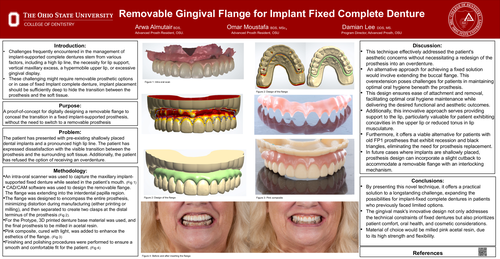
Removable Gingival Flange for Implant Fixed Complete Denture
Introduction:
•
Challenges frequently encountered in the management of
implant supported complete dentures stem from various
factors, including a high lip line, the necessity for lip support,
vertical maxillary excess, a hypermobile upper lip, or excessive
gingival display.
•
These challenging might require removable prosthetic options
or in case of fixed Implant complete denture, implant placement
should be sufficiently deep to hide the transition between the
prosthesis and the soft tissue.
Purpose:
A proof
of concept for digitally designing a removable flange to
conceal the transition in a fixed implant supported prosthesis,
without the need to switch to a removable prosthesis
Problem
The patient has presented with pre
existing shallowly placed
dental implants and a pronounced high lip line. The patient has
expressed dissatisfaction with the visible transition between the
prosthesis and the surrounding soft tissue. Additionally, the patient
has refused the option of receiving an overdenture.
Methodology:
•
An intra
oral scanner was used to capture the maxillary implant
supported fixed denture while seated in the patient’s mouth. (Fig
•
CAD/CAM software was used to design the removable flange.
The flange was extending into the interdental papilla region.
•
The flange was designed to encompass the entire prosthesis,
minimizing distortion during manufacturing (either printing or
milling), and then separated to create two clasps at the distal
terminus of the prosthesis (Fig
•
For the Protype, 3D printed
denture base material was used, and
the final prosthesis to be milled in acetal resin.
•
Pink composite, cured with light, was added to enhance the
esthetics of the flange. (Fig 3)
•
Finishing and polishing procedures were performed to ensure a
smooth and comfortable fit for the patient. (Fig 4)
Discussion
•
This technique effectively addressed the patient's
aesthetic concerns without necessitating a redesign of the
prosthesis into an overdenture.
•
An alternative approach for achieving a fixed solution
would involve extending the buccal flange. This
overextension poses challenges for patients in maintaining
optimal oral hygiene beneath the prosthesis
•
This design ensures ease of attachment and removal,
facilitating optimal oral hygiene maintenance while
delivering the desired functional and aesthetic outcomes.
•
Additionally
, this innovative approach serves providing
support to the lip, particularly valuable for patient exhibiting
concavities in the upper lip or reduced tonus in lip
musculature
•
Furthermore, it offers a viable alternative for patients with
old FP1 prostheses that exhibit recession and black
triangles, eliminating the need for prosthesis replacement.
•
In
future cases where implants are shallowly placed,
prosthesis design can incorporate a slight cutback to
accommodate a removable flange with an interlocking
mechanism.
Conclusions:
•
By presenting this novel technique, it
offers a practical
solution to a longstanding challenge, expanding the
possibilities for implant fixed complete dentures in patients
who previously faced limited options
•
The
gingival mask's innovative design not only addresses
the technical constraints of fixed dentures but also prioritizes
patient comfort, oral health, and cosmetic considerations
•
Material of choice would be milled
pink acetal resin, due
to its high strength and flexibility.