127 posters, 2 topics, 24 sessions, 326 authors, 85 institutions
ePostersLive by SciGen Technologies S.A. All rights reserved.
2023 ACP ANNUAL SESSION
October 25-28 | San Diego, CA

150
The Accuracy of a Virtual Facebow Record: A Comparison Between Smartphone 3D Scanner and Industrial 3D Scanner
Poster Presenter
Part of Topic
Original Research
The Accuracy of a Virtual Facebow Record:
A Comparison Between Smartphone 3D Scanner and Industrial 3D Scanner
Robert Ault, Janet Zalucha , Hasan Yousif Khalid Al Yousuf , Carl Pogoncheff , Fei Liu , Herschel Ungar , Junying Li
Department of Prosthodontics, Department of Biologic & Materials Sciences, University of Michigan School of Dentistry
BACKGROUND
Collecting proper and accurate patient specific information is important for prosthodontic rehabilitation. The three-dimensional position of the maxilla, interarch relationship, reference planes and points of the face greatly influence the prosthetic treatment plan and design. The virtual patient is formulated through the superimposition of various three-dimensional images taken from the live patient by use of a facial scanner, through the application of a virtual facebow technique. A virtual articulator can then be integrated with the virtual patient further assisting CAD/CAM prosthetics.
With the advent of advancements in consumer technology, smartphone devices have gained the capability to perform three-dimensional scanning. In comparison to bulky and costly industrial scanners and stereophotogrammetry devices, smartphones present a cost-effective and user-friendly option. Nonetheless, the equivalence of accuracy between smartphone-based records and industrial scanner based virtual facebow records (VFR) remains uncertain.
OBJECTIVES
To compare the accuracy of virtual facebow records obtained using an industrial 3D scanner with those captured by a smartphone-based 3D scanner.
MATERIAL AND METHODS
Approved by the Institutional Review Boards of the University of Michigan (Study ID: HUM00210049), fifty virtual facebow records were conducted on ten participants utilizing a smartphone 3D scanner and an industrial scanner. Five scans per participant on each device were completed with a virtual facebow attached to their upper arch. Maxillary intraoral scans were obtained and aligned to each subject’s face utilizing the facebow fork.
Trueness and precision were calculated through superimposition to a generated stereolithography face scan calculated from a computed tomography (CBCT) image. Deviations were calculated between points placed on the intraoral scan at #9, #14, and #3 employing a generated Python Script in Blender.
Deviations were categorized angularly and linearly to compute precision and trueness.
Further differences were investigated utilizing the Mann-Whitney U test with significance of p value of <0.01.
RESULTS
Data from one subject was identified as an outlier and was therefore excluded from the statistical analysis. Therefore, data from 9 subjects were analyzed.
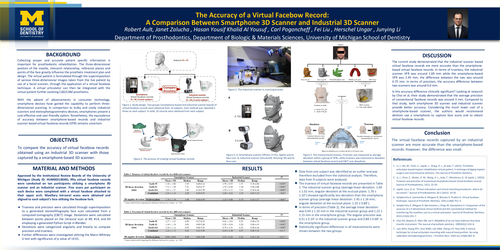
The trueness of virtual facebow records are presented in Table 1. The industrial scanner group (average linear deviation: 1.69 ± 1.02 mm; angular deviation at the occlusal plane: 1.78 ± 1.10°) showed significantly less deviation than the smartphone scanner group (average linear deviation: 2.45 ± 1.16 mm; angular deviation at the occlusal plane: 1.25 ± 0.88°).
In terms of precision (Table 2), the average linear deviation was 0.64 ± 1.10 mm in the industrial scanner group and 1.22 ± 1.15 mm in the smartphone group. The angular precision was 0.51 ± 0.24° in the industrial scanner group and 0.88 ± 0.68° in the smartphone group.
Statistically significant differences in all measurements were shown between the two groups.
DISCUSSION
The current study demonstrated that the industrial scanner based virtual facebow records are more accurate than the smartphone-based virtual facebow records. In terms of trueness, the industrial scanner VFR was around 1.69 mm while the smartphone-based VFR was 2.45 mm, the difference between the two was around 0.75 mm. In terms of precision, the accuracy difference between two scanners was around 0.6 mm.
Is this accuracy difference clinically significant? Looking at research by Choi et al, their study demonstrated that the average precision of conventional facebow records was around 3 mm. Compared to that study, both smartphone 3D scanner and industrial scanner provide better accuracy. Considering the much lower cost of a smartphone-based scanner, the authors would recommend dentists use a smartphone to capture face scans and to obtain virtual facebow records.
Conclusion
The virtual facebow records captured by an industrial scanner are more accurate than the smartphone-based records. However, the difference was small.