127 posters, 2 topics, 24 sessions, 326 authors, 85 institutions
ePostersLive by SciGen Technologies S.A. All rights reserved.
2023 ACP ANNUAL SESSION
October 25-28 | San Diego, CA

15
Patient preference between the Prosomnus IA and TAP 3 mandibular advancement devices in patients diagnosed with bruxism.
Poster Presenter
Authors
Affiliations
Part of Topic
Original Research
Patient preference between the ProSomnus IA and TAP 3 mandibular advancement devices in patients diagnosed with bruxism
Andrew S. Ryser CPT, DDS • Kyung Kim COL, DDS, MS • Jennifer Sabol COL, DDS, MS • Steven Handel MAJ, DMD
U.S. Army Advanced Education in Prosthodontics, Fort Gordon, GA and Uniformed Services University of the Health Sciences Postgraduate Dental College
INTRODUCTION: Mandibular advancement devices (MAD) are prescribed to treat obstructive sleep apnea (OSA). As awareness and diagnosis of OSA increases, dentists will be treating these conditions more frequently. Bruxism, which can cause wear and damage to the dentition, is highly prevalent in the American population, with an estimated 10-15% of the population having been diagnosed with nocturnal bruxism. For patients that have both OSA and experience bruxism, an occlusal device may address both concerns.
PURPOSE: The purpose of this study is to evaluate the preference of MAD appliances for patients diagnosed with OSA and bruxism using TAP 3 and modified ProSomnus IA oral appliances.
MATERIALS AND METHODS:
Twelve patients diagnosed with OSA were referred for fabrication of a mandibular advancement device (MAD). At the initial appointment each patient was evaluated for signs and symptoms of bruxism. If bruxism was diagnosed the patient was informed of and given the choice to enroll in the research project. Once enrolled and informed consent obtained, digital scans of the patient were acquired using the Primescan (Dentsply Sirona) while in 50-60% of maximum protrusion. The ProSomnus IA was modified to have wings extended 2mm laterally to give similar range of lateral movement as the TAP 3. Patients were randomly chosen for which MAD would be delivered first. One MAD was delivered and used for one month. After one month the patient returned to the clinic and received the alternative MAD. At the final appointment, the patient was asked which device was preferred for long-term treatment.
RESULTS:
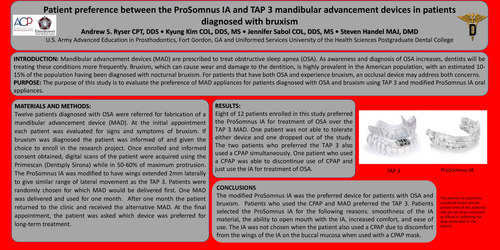
Eight of 12 patients enrolled in this study preferred the ProSomnus IA for treatment of OSA over the TAP 3 MAD. One patient was not able to tolerate either device and one dropped out of the study. The two patients who preferred the TAP 3 also used a CPAP simultaneously. One patient who used a CPAP was able to discontinue use of CPAP and just use the IA for treatment of OSA.
CONCLUSIONS
The modified ProSomnus IA was the preferred device for patients with OSA and bruxism. Patients who used the CPAP and MAD preferred the TAP 3. Patients selected the ProSomnus IA for the following reasons: smoothness of the IA material, the ability to open mouth with the IA, increased comfort, and ease of use. The IA was not chosen when the patient also used a CPAP due to discomfort from the wings of the IA on the buccal mucosa when used with a CPAP mask