127 posters, 2 topics, 24 sessions, 326 authors, 85 institutions
ePostersLive by SciGen Technologies S.A. All rights reserved.
2023 ACP ANNUAL SESSION
October 25-28 | San Diego, CA

132
Prosthodontic Treatment Considerations for Patients with Obstructive Sleep Apnea
Poster Presenter
Authors
Affiliations
Part of Topic
Original Research
Prosthodontic Treatment Considerations for Patients with Obstructive Sleep Apnea
Moran, Tess, DDS; Shah, Kumar, BDS, MS, FACP, FAP
University of California, Los Angeles School of Dentistry
Introduction
Obstructive sleep apnea (OSA) is a sleep-related breathing disorder characterized by loud snoring and apneas/hypopneas despite respiratory movements. Untreated OSA may lead to cardiovascular (CV) and metabolic comorbidities1.
OSA has implications on prosthodontic treatment: untreated OSA is often associated with caries, temporomandibular joint pathology, loss of restorative space from heavy wear, and breakdown of natural and restored dentition, while successful treatment of OSA may cause significant changes in occlusion. Therefore, considerations for treatment of these patients must be made pre-prosthetically, during treatment, and in the maintenance phase.
Case Report
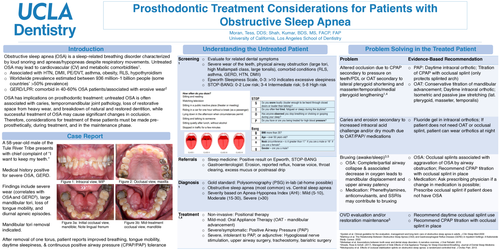
A 58-year-old male of the Tule River Tribe presents with chief complaint of “I want to keep my teeth.”
Medical history positive
for severe OSA, GERD.
Findings include severe wear (correlates with OSA and GERD5), large mandibular tori, loss of tongue mobility, and diurnal apneic episodes.
Mandibular tori removal indicated.
After removal of one torus, patient reports improved breathing, tongue mobility, daytime sleepiness, & continuous positive airway pressure (CPAP/PAP) tolerance
Figure 1: Intraoral view, MIP
Figure 2: Occlusal view, maxilla
Figure 3a: Initial occlusal view, mandible; Note lingual frenum
Figure 3b: Mid-treatment occlusal view, mandible
Screening1 oEvaluate for related dental symptoms oSevere wear of the teeth, physical airway obstruction (large tori, high Mallampati class, large tonsils), comorbid conditions (RLS, asthma, GERD, HTN, DMII) oEpworth Sleepiness Scale, 0-3: >10 indicates excessive sleepiness oSTOP-BANG: 0-2 Low risk; 3-4 Intermediate risk; 5-8 High risk o o o o o o o o o o o o Referrals oSleep medicine: Positive result on Epworth, STOP-BANG oGastroenterologist: Erosion, reported reflux, hoarse voice, throat clearing, excess mucus or postnasal drip o Diagnosis1 oGold standard: Polysomnography (PSG) in-lab (at-home possible) oObstructive sleep apnea (most common) vs. Central sleep apnea oSeverity based on Apnea-Hypopnea Index (AHI) : Mild (5-10), Moderate (15-30), Severe (>30) o Treatment1,4 oNon-invasive: Positional therapy oMild-mod: Oral Appliance Therapy (OAT - mandibular advancement) oSevere/symptomatic: Positive Airway Pressure (PAP) oSevere, intolerant to PAP, or adjunctive: Hypoglossal nerve stimulation, upper airway surgery, tracheostomy, bariatric surgery oProblem Evidence-Based Recommendation Altered occlusion due to CPAP secondary to pressure on teeth/PDL or OAT secondary to lateral pterygoid shortening and masseter/temporalis/medial pterygoid lengthening1,4 oPAP: Daytime intraoral orthotic; Titration of CPAP with occlusal splint (only protects splinted arch) oOAT: Conservative titration of mandibular advancement; Daytime intraoral orthotic; Isometric and passive jaw stretching (lat. pterygoid, masseter, temporalis) o Caries and erosion secondary to increased intraoral acid challenge and/or dry mouth due to OAT/PAP/ medications o oFluoride gel in intraoral orthotics; If patient does not need OAT or occlusal splint, patient can wear orthotics at night o Bruxing (awake/sleep)3,5 oOSA: Complete/partial airway collapse & associated decrease in oxygen leads to mandibular displacement and upper airway patency oMedication: Phenethylamines, anticonvulsants, and SSRIs may contribute to bruxing oOSA: Occlusal splints associated with aggravation of OSA by airway obstruction; Recommend CPAP titration with occlusal splint in place oMedication: Ask prescribing physician if a change in medication is possible; Prescribe occlusal splint if patient does not have OSA OVD evaluation and/or restoration maintenance5 oRecommend daytime occlusal splint use oRecommend CPAP titration with occlusal splint in place
Problem Solving in the Treated Patient
1Epstein et al. Clinical guideline for the evaluation, management and long-term care of obstructive sleep apnea in adults. J Clin Sleep Med 2009
2Mahfouz et al. The Relationship Between Obstructive Sleep Apnea (OSA) and Gastroesophageal Reflux Disease (GERD) in Inpatient Settings: A Nationwide Study. Cureus. 2022.
3Wetselaar et al. Associations between tooth wear and dental sleep disorders: A narrative overview. J Oral Rehabil. 2019
4Sheats, Rose & Schell. (2017). Management of Side Effects of Oral Appliance Therapy for Sleep-Disordered Breathing. Journal of Dental Sleep Medicine. 5Nikolopoulou et al. Effects of occlusal stabilization splints on obstructive sleep apnea: a randomized controlled trial. J Orofac Pain. 2013.